
System specs
FireShield water system specs
A wildfire system is only as good as the water it can actually deliver. Here is how a FireShield system is sized — flow per zone, pipe, pressure, rotor throw, pump, foam — with an example for a real property and a calculator for your own pool or tank.
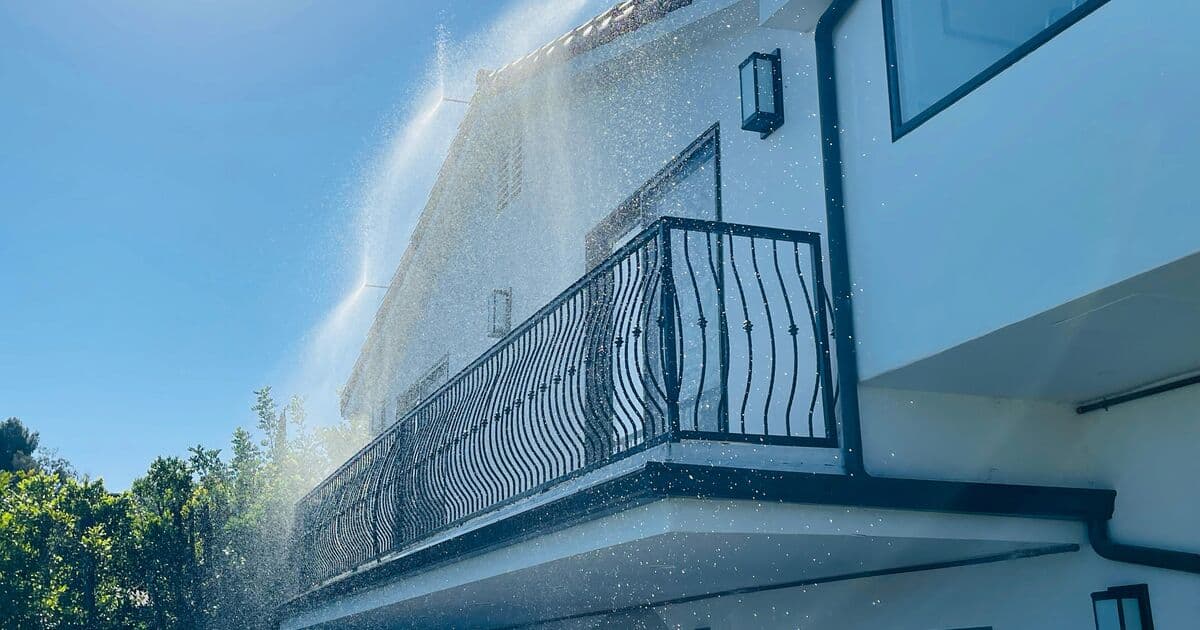
How it is built
The standard building blocks
16–20 GPM per line
Each zone line is designed for about 16 to 20 gallons per minute — enough to wet a roof edge or a side of the house, small enough that a household supply or a pool pump can keep up.
1-inch pipe, copper preferred
One-inch lines, copper where we can. Copper holds up to radiant heat and UV far better than plastic on an exterior wall.
Backflow preventer
Keeps system water, and any foam, out of your drinking water. Required on every connection to the street supply.
Pressure regulator
Holds the system at its design pressure so sprinkler heads spray where they were aimed and fittings are not over-stressed.
Water-hammer arrestor
Absorbs the pressure spike when a valve closes, protecting joints and the controller’s valves.
Booster pump (optional)
Where street pressure is low, a booster brings it up to the design pressure before it reaches the zones.
Pool or tank pump
Default: 3 HP, three-phase, driven by a variable-frequency drive (VFD) sized to the motor’s amperage, on its own dedicated circuit. The VFD starts the motor gently and holds pressure steady as zones change.
Auto-reset pressure relief valve
Every pool or tank pump also gets a mechanical relief valve. A pressure sensor alone is not enough: if its cable to the drive is cut, faulty or shorted, the drive cannot tell it should stop and the pump keeps pushing. The valve opens on its own, sends the excess back to the pool so no water is lost, and resets itself.
Air purge valves
Let trapped air out of the lines automatically, so the system fills and drains cleanly, water hammer is reduced and the plumbing lasts longer.
Expansion tank
Absorbs pressure surges and expansion in the system, taking strain off pipes, joints and the pump.
Class A firefighting foam
Injected into the line at 0.1–1.0 %. For wetting a structure the usual setting is 0.5–1.0 %; at 0.5 %, one gallon of concentrate treats 200 gallons of water.
Roof and ground rotors
How far a rotor throws, and how much it uses
The rotor we install is a 4-inch stainless-steel pop-up rotor with check valve: 1-inch inlet, 25° trajectory, built-in drain check valve (holds up to about 15 ft of elevation). We use two nozzles. Figures are the manufacturer’s published performance at the rotor, for 50–80 PSI.
≈10 GPM nozzle
Runs from 50 PSI. Use where pressure is modest or several rotors share a line.
| Pressure | Throw (radius) | Flow |
|---|---|---|
| 50 PSI | 49 ft | 10.3 GPM |
| 60 PSI | 50 ft | 11.3 GPM |
| 70 PSI | 51 ft | 12.2 GPM |
| 80 PSI | 51 ft | 13.0 GPM |
≈20 GPM nozzle
Needs at least 60 PSI at the rotor; not rated at 50 PSI. Longest throw, one rotor per line.
| Pressure | Throw (radius) | Flow |
|---|---|---|
| 50 PSI | — | not rated |
| 60 PSI | 62 ft | 21.3 GPM |
| 70 PSI | 64 ft | 23.0 GPM |
| 80 PSI | 65 ft | 24.5 GPM |
Worked example
Main house and guest house, 5,400 sq ft, 9 zones
| Zones | What | Heads | Flow |
|---|---|---|---|
| 1–4 | Eave sprayers | 40 (10 per zone) | 20 GPM per zone (≈2 GPM per sprayer) |
| 5–9 | Roof and ground rotors | 5 (1 per zone) | ≈10–13 GPM (≈10 GPM nozzle) or 21–25 GPM (≈20 GPM nozzle, 60 PSI+) |
- Ten eave sprayers share one line at 20 GPM, so a single zone wets a full run of eaves.
- Each rotor has its own zone, so its pressure never has to be shared.
- A water-hammer arrestor sits on the supply; backflow preventer and regulator at the connection.
- Zones run as many at once as the water pressure supports (on most homes, one at a time, in sequence), or you choose the ones facing the fire for the next start — the water goes where it is needed instead of everywhere at once.
Pressure budget for one 20 GPM eave line
Where the pressure goes between the street and the last head. In 1-inch copper, 20 GPM loses about 0.1 PSI per 100 ft of pipe, and every foot of height costs 0.433 PSI.
- Street pressure (example)
- 70.0 PSI
- After the pressure regulator
- 65.0 PSI
- 80 ft of 1-inch copper
- − 0.1 PSI
- Up 20 ft to the eaves
- − 8.7 PSI
- Fittings
- − 3.0 PSI
- Zone valve
- − 3.0 PSI
- Left at the heads
- 50.3 PSI
If your street pressure is too low for that, a booster pump makes up the difference — that is decided at the inspection, from a measured pressure, not a guess.
How long it lasts
Pool and foam runtime
| Gallons | At 16 GPM | At 20 GPM |
|---|---|---|
| 10,000 | 10 h 25 min | 8 h 20 min |
| 15,000 | 15 h 38 min | 12 h 30 min |
| 20,000 | 20 h 50 min | 16 h 40 min |
| 25,000 | 26 h 03 min | 20 h 50 min |
| 30,000 | 31 h 15 min | 25 h 00 min |
| Concentrate | Treats | Lasts at 16 GPM | Lasts at 20 GPM |
|---|---|---|---|
| 5 gal | 1,000 gal | 1 h 03 min | 50 min |
| 15 gal | 3,000 gal | 3 h 08 min | 2 h 30 min |
| 30 gal | 6,000 gal | 6 h 15 min | 5 h 00 min |
| 50 gal | 10,000 gal | 10 h 25 min | 8 h 20 min |
The controller runs as many zones at once as the water pressure supports; on a typical home supply that is one line at a time, so a single line’s 16–20 GPM is the whole draw. Choosing only the zones that face the fire stretches the water and the foam further.
Your numbers
Water and foam calculator
Enter your pool or tank size and see how long it lasts, with and without foam.
- Flow (one zone at a time)
- 20 GPM
- Water lasts
- 16 h 40 min
- Foam lasts
- 8 h 20 min
- Foam concentrate used
- 0.10 gal/min
- Water treated per gallon of foam
- 200 gal
- Foam to treat all of the water
- 100 gal
The foam runs out first; the system is designed to keep wetting with plain water after that.
If everything fails
When the grid, the network and the street water all fail
Grid down
The controller, its valves and its communications are designed to run on the battery (solar top-up optional). The pool or tank pump is a 3 HP motor and needs the grid or a standby generator; size it with your electrician (a generator in the 10 kW class is typical for this pump with a VFD). Or choose the FireShield Off-Grid Pool Package, which runs the pump from the FireShield Power Hub with no generator, no inverter and no grid.
Cell network down
Wi-Fi and satellite remain, and a button on the controller, a remote trigger or an on-site detector can start it locally without any network.
Street water gone
The controller is designed to bring in the pool, tank or well when mains pressure is not enough and the system is running — which is why the pump’s power source matters.
110 °F, windy, and nobody home
The controller is solid-state, has no fan and runs only firmware; the valve manifolds have no water pressure until the system runs. Wind shortens how far the water sprays, so we aim the heads into the usual fire-season wind, and you can choose zones to put the water on the side facing the fire.
Illustrative figures for planning. Every FireShield system is designed for its own property: street pressure, elevation, pipe runs and water sources are measured at the inspection. The FireShield Wildfire Defense System is designed to support wildfire mitigation, not to provide guaranteed protection.
Beyond the numbers
These numbers hold anywhere in the country; your engineer sizes them for your property and water supply.
- Zone capacity
- Up to 36 zones per controller, where typical systems top out at 6 to 8; add controllers for larger properties.
- No property too large
- Several controllers can protect one property, from a main house to guest houses, barns and acreage.
- Zero-touch operation
- Fully automated once installed; the numbers on this page run without anyone pressing a button.
- Water from what you have
- Mains, pool, tank or well, sized for your property.
- Concealed plumbing
- Built into walls and roof on new construction; routed with minimal visible impact on existing homes.
- Engineered per home
- A dedicated engineer turns these numbers into a design for your property, with parts made to fit it.