FireShield

Comparison

FireShield vs the competition: which one is better?

Both are automated exterior wildfire defense systems. Both wet your roof and the ground around it before embers arrive. The difference is how much of the decision stays with you.

Our answer

FireShield, if you want to set the rules yourself.

FireShield is built around control; You set your own trigger distance and your own countdown, rather than a single fixed setting. You can also schedule a start time in advance. You can deploy water to just one side of the property instead of soaking the whole perimeter. On a ridge, on a canyon lot, or with a fire already burning nearby, that level of control over where and when water is sprayed, can be difference between saving or losing your property.

Written honestly

  • We designed and created FireShield Wildfire Defense systems. All information provided here are accurate description of what FireShield systems do.
  • The competition’s capabilities are described only from what they publish about their own system. Where they publish nothing, we say so.
  • All FireShield screenshots and images are the capabilities that are currently existing and in-practice.
  • Simply install FireShield app, experiment and see our capabilities first hand.

Point by point

Eight points that differentiates us from anyone else.

Each one is a question an owner actually asks, what we do about it, and what the competition publishes about it. The side-by-side table is at the end.

How close does a fire have to get, and how long does it wait before spraying?

Consumer sets the distance and the wait time

FireShield

You can easily adjust both activation distance and the wait through the app, from anywhere. Default values are 6 miles and 9 minutes. No re-programming or technician needed.

The competition, as published

A fixed seven-mile trigger and a fixed ten-minute countdown. You can not change those constants in the app.

  • A premature activation of your system can deplete your precious pool water too early.
  • A fixed pair cannot know whether your house is on a flat suburban street or at the head of a canyon.
  • Even if a premature trigger does not affect your water source, it can deplete your fire-fighting foam tank.
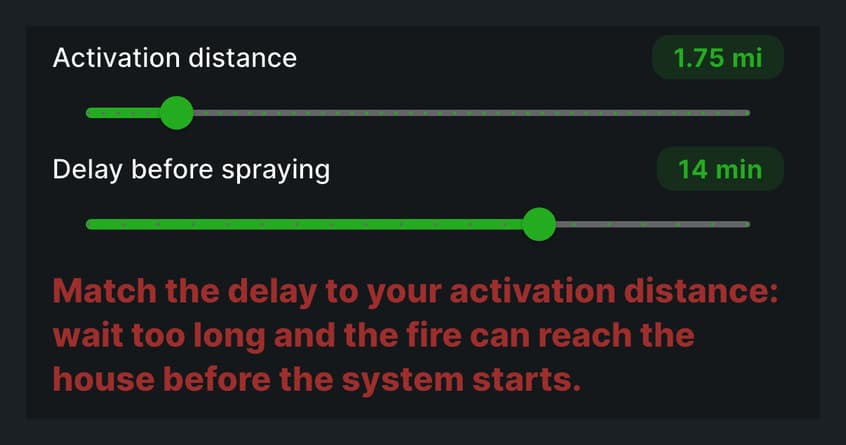
The activation distance and delay sliders in the FireShield app, with the warning the app prints under them
Both sliders, and the warning, from the shipping app.
The long version: You pick the distance. You pick the wait.

Where does that distance number actually come from?

An automatic system is only as good as the shape of the fire it measures to

FireShield

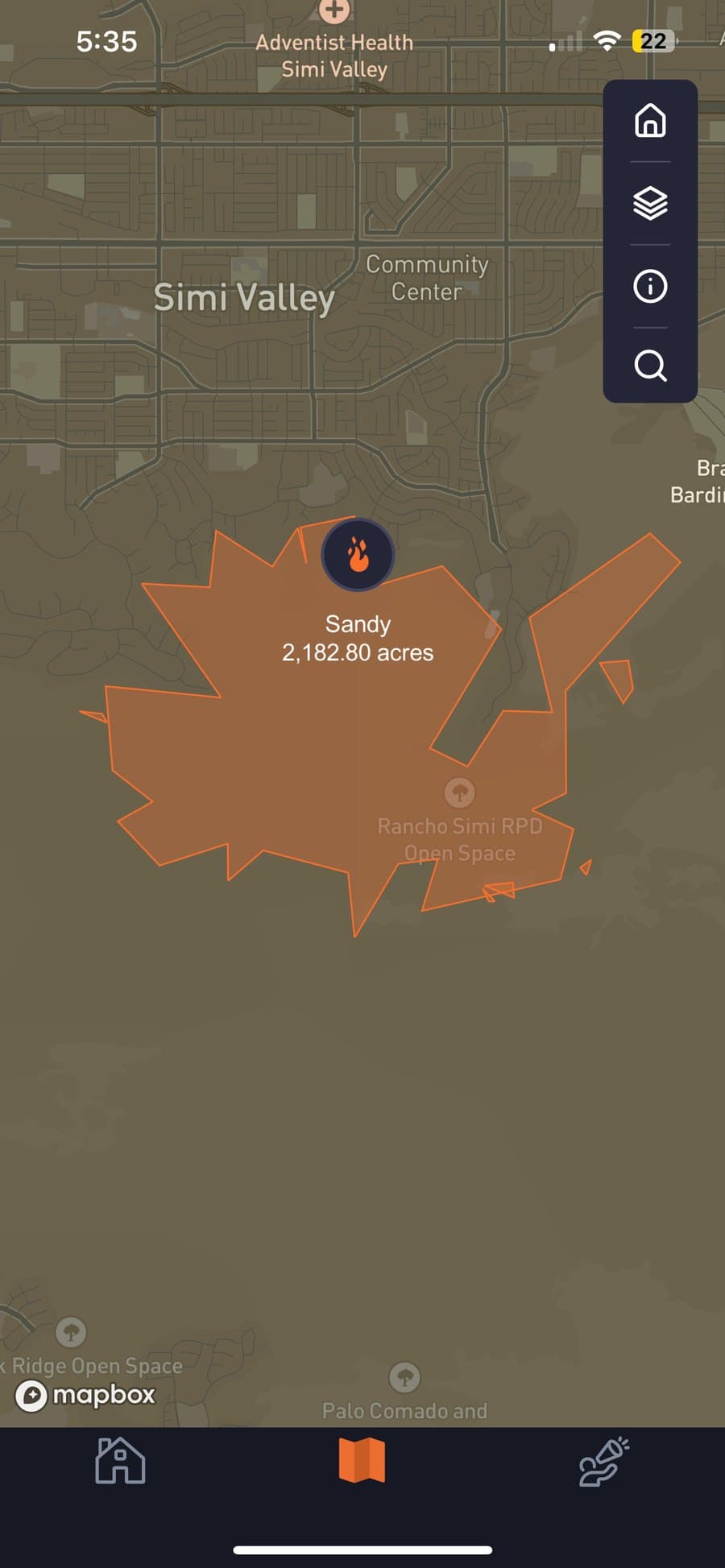
Full-resolution fire perimeters — the same detail the agencies publish and the same detail Watch Duty draws. The distance is measured to the real edge of the burn.

The competition, as published

The competition’s perimeter appears downsampled: the same fire, with the detail taken out of it. An activation or lack of activation due to downsampling can result in catastrophe.

  • Activates late — the simplified edge sits further away than the fire really is, so the countdown starts after it should have.
  • Activates early — the edge bulges the wrong way, the system runs for a fire that was never close, and the water is gone.
  • Does not activate — smoothed hard enough, the boundary never crosses your line at all.
  • Tells you the wrong thing — you open the app to decide, and the picture you are deciding from is not the fire.

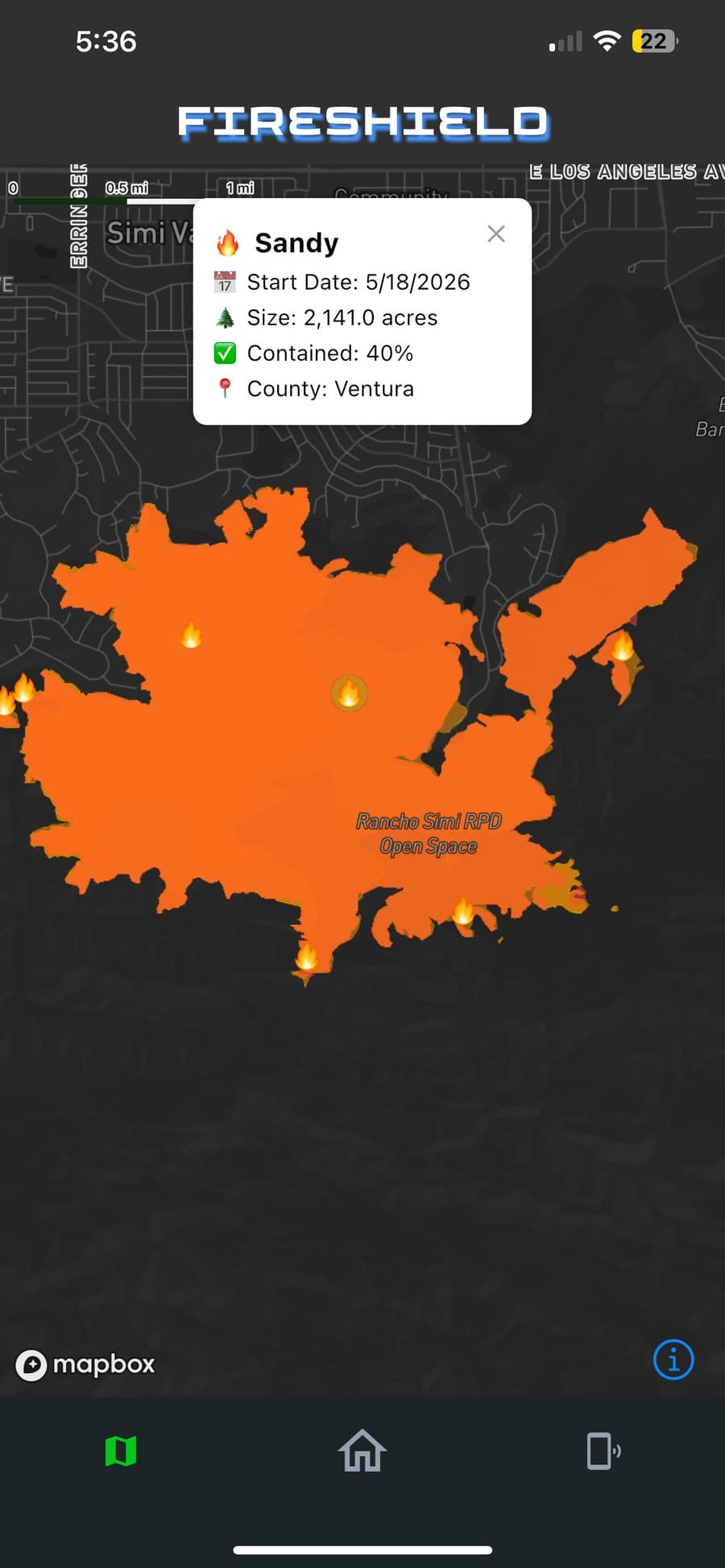
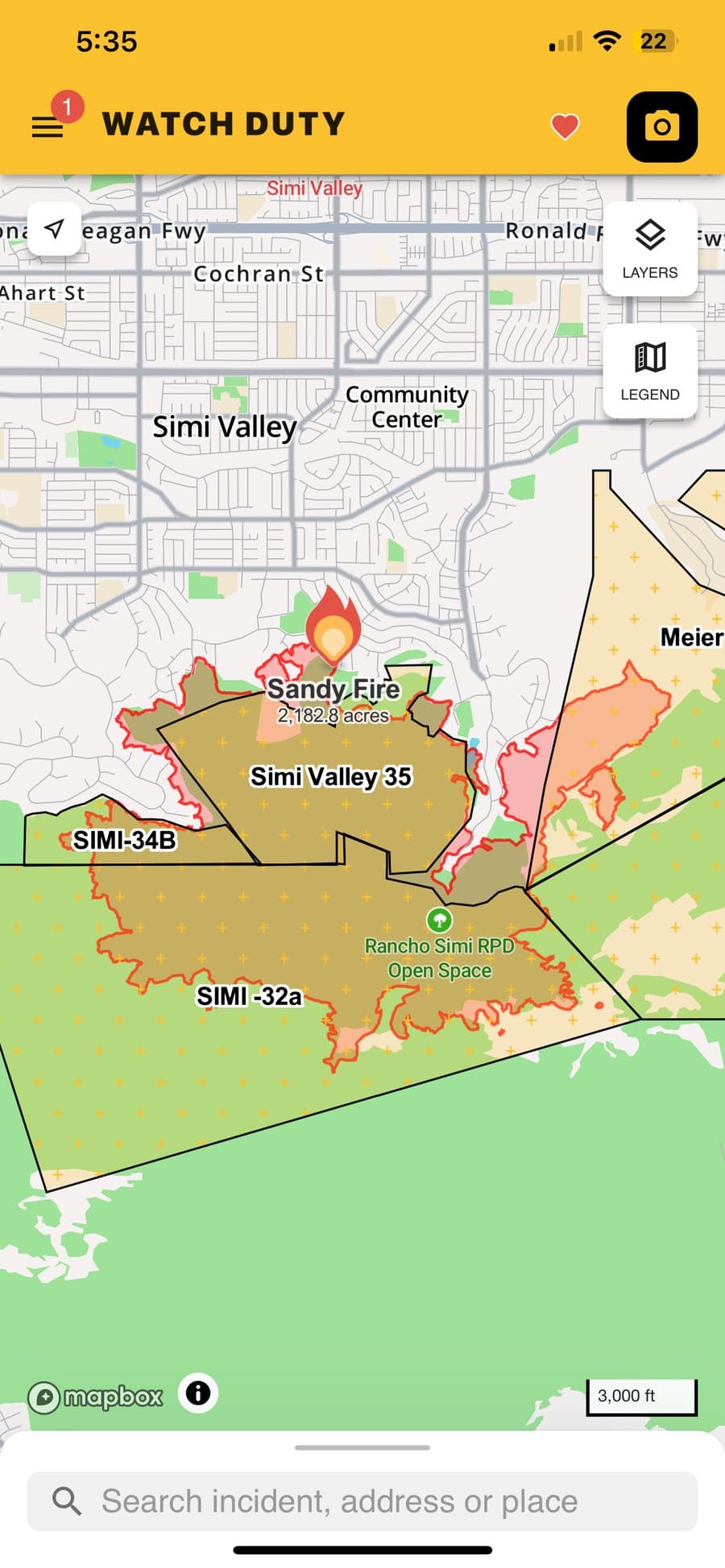
Sandy Fire · Ventura County · 18 May 2026 · 2,141+ acres. The same fire, at the same time, in three apps.

FireShield: Full-resolution perimeter
FireShieldFull-resolution perimeter
Watch Duty: Full-resolution perimeter
Watch DutyFull-resolution perimeter
Competitor app: Downsampled perimeter
Competitor appDownsampled perimeter
The long version: Distance tells you where a fire is. Wind tells you where it is going.

Your neighbor's house is alight and the wind is on one fence line. Where does the water go?

Water the side that is burning, not the whole property

FireShield

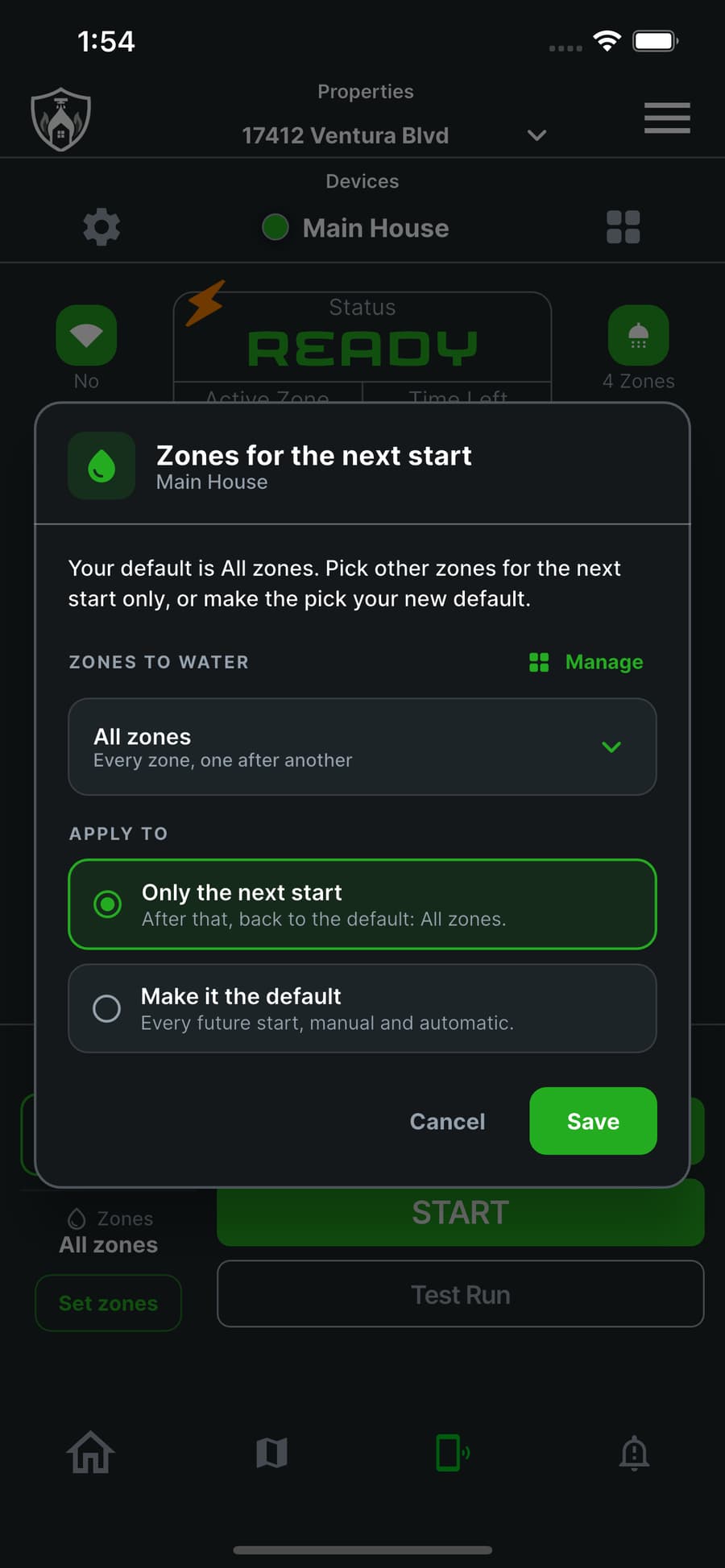
Direct water at a specific side of your house; choose the zones for the next start only and it reverts afterwards, or make the selection the default for every start, manual and automatic. Concentrating the supply means more pressure and a longer run where it matters.

The competition, as published

Does not offer an option to choose which zones to be activated. You can focus on or skip zones.

  • Every system of this kind runs in zones — no household supply can feed a whole property at once.
  • The question is who decides the selection, and how late they can change it.
  • Twelve zones as standard, expandable past twenty-four on the same controller.
FireShield app: choosing which zones to water on the next start, with the option to apply it only once or make it the default
For the next start only, or from now on.
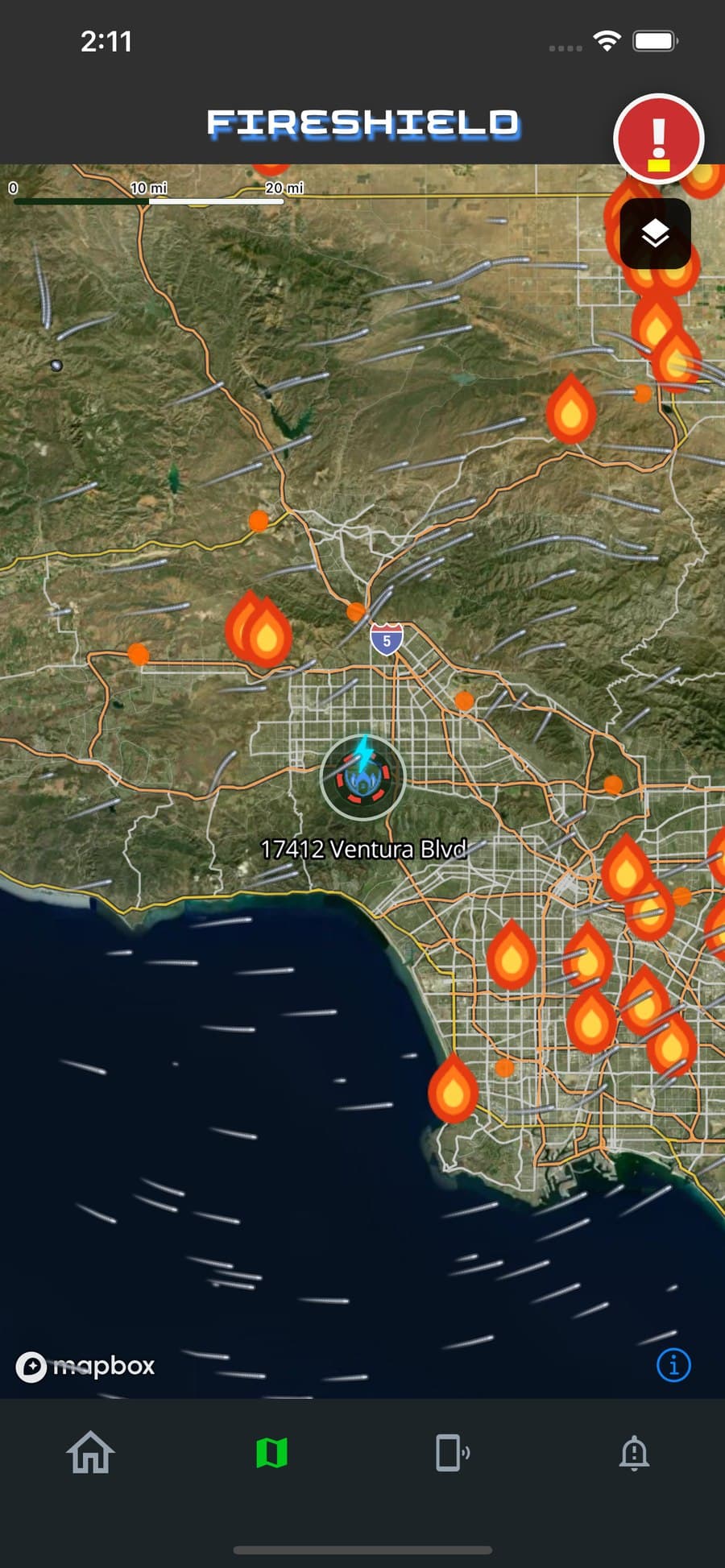
FireShield app fire map showing many separate fires around Los Angeles, each one tracked individually
Every fire tracked separately, so one decision is never a decision about all of them.

You are evacuating, and you want to activate in 2 hours. Can you schedule it before you go?

Schedule it to start before you leave

FireShield

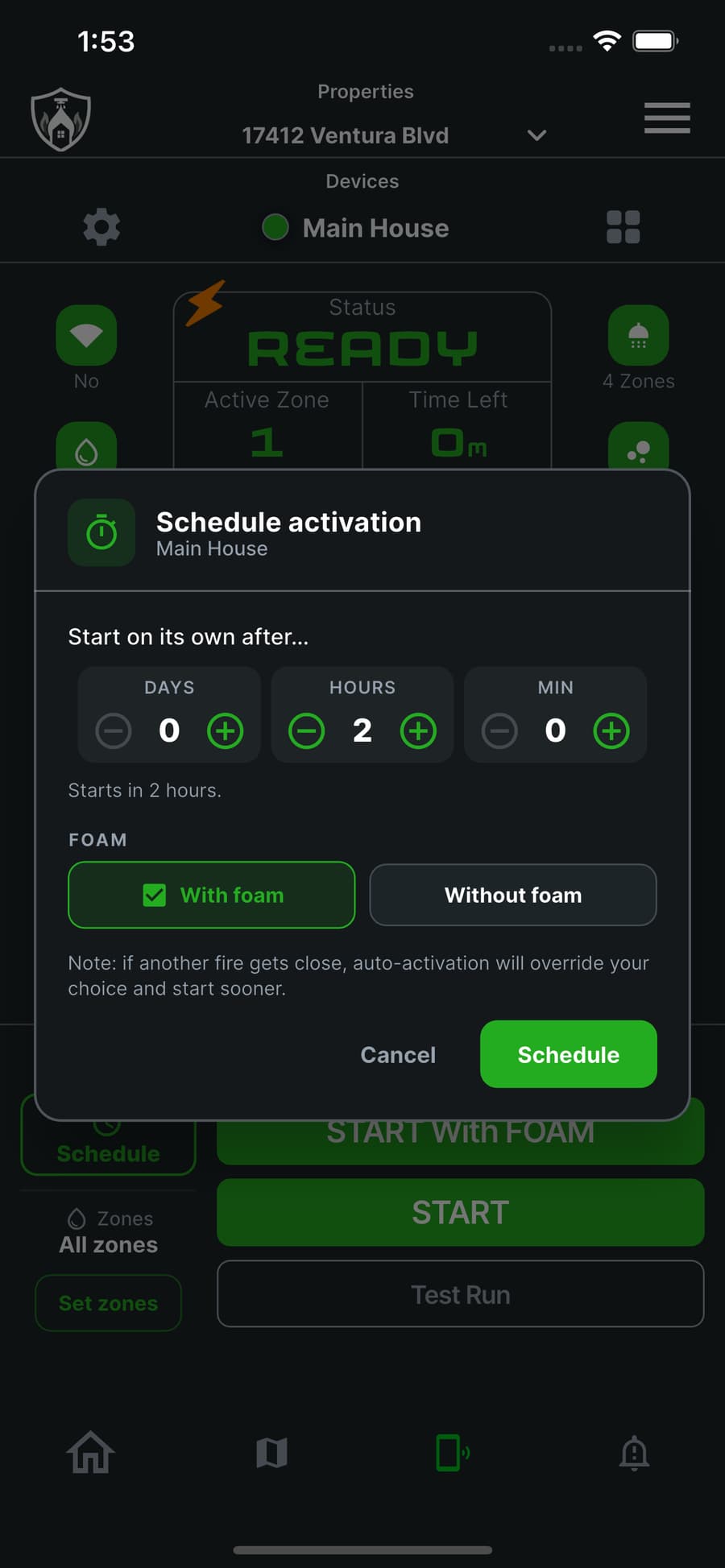
Tell it to start on its own in a set number of days, hours or minutes, with or without foam, so the property is already hydrated at the hour you expect the front.

The competition, as published

Manual start and remote control from their app are published. A future-dated schedule is not.

  • If you leave, you may not get a chance to activate later while on the road. Schedule it now for a future activation, and it will activate as you instructed, whether you being there or not.
  • A schedule never blocks the fire. If a wildfire crosses your activation distance first, automatic activation takes over and starts sooner.
FireShield app: scheduling an activation to start on its own after a set number of days, hours and minutes, with a foam choice
Schedule a start days ahead. A closer fire still overrides it.

You disagree with it and press STOP. What happens sixty seconds later?

STOP does not mean stop and forget

FireShield

When you stop an automatic activation, it record how far away that fire was. Meanwhile, the system monitors that fire closely and if fire starts moving toward your house, it will activate again.

The competition, as published

Overriding an activation is published. What happens on the next check is not. If same fire starts moving again after couple of hours, you don't know what will happen.

  • A different fire is judged on its own — a new ignition is a new decision.
  • That fire closing in re-arms the system at half the distance it was, or a full mile nearer, whichever it reaches first.
  • The hold expires after twenty-four hours in any case, so a fire that parks nearby cannot leave you disarmed indefinitely.
  • You can lift it yourself, with the consequence spelled out first. A brief data glitch cannot quietly erase it.
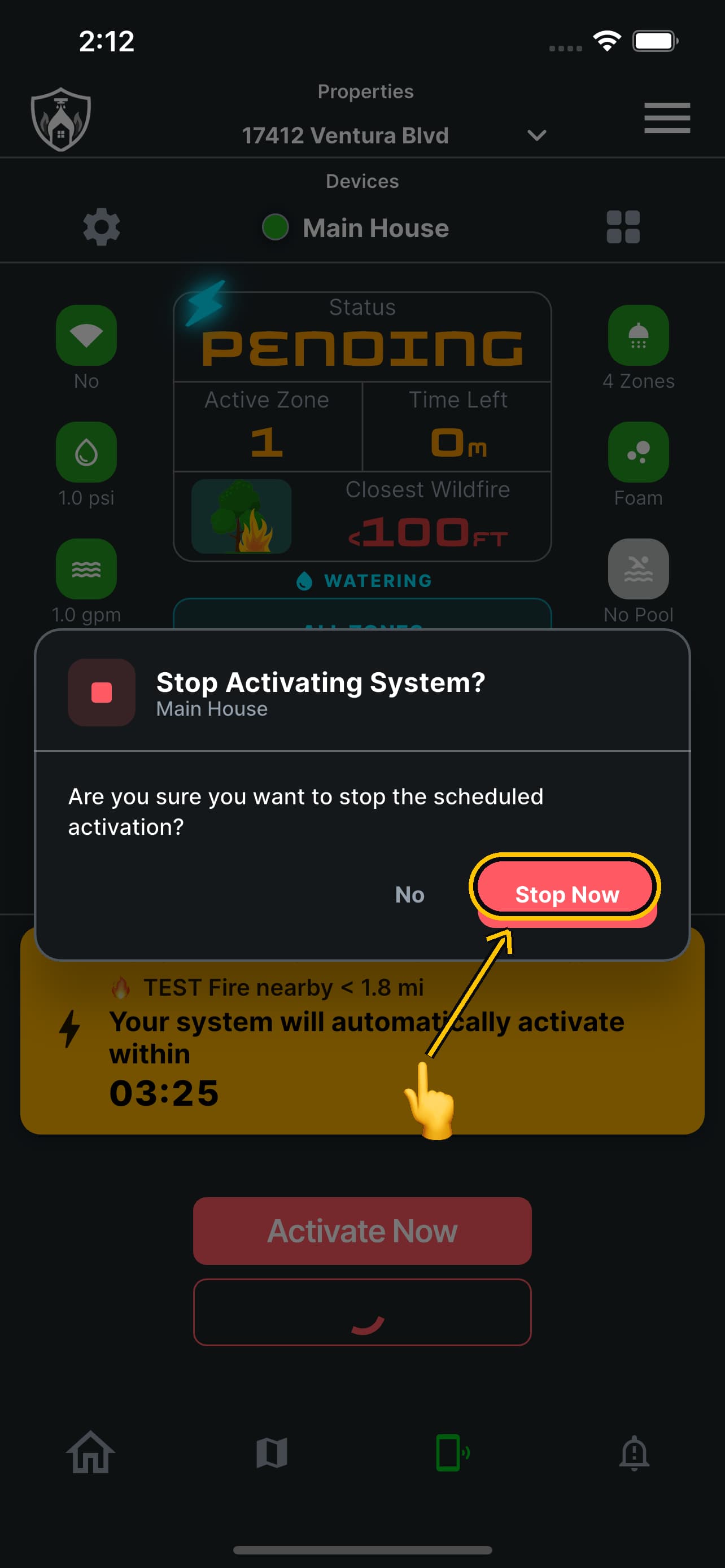
The countdown running, and the button that stops it.
FireShield app: the confirmation shown before stopping an automatic activation
It asks once.
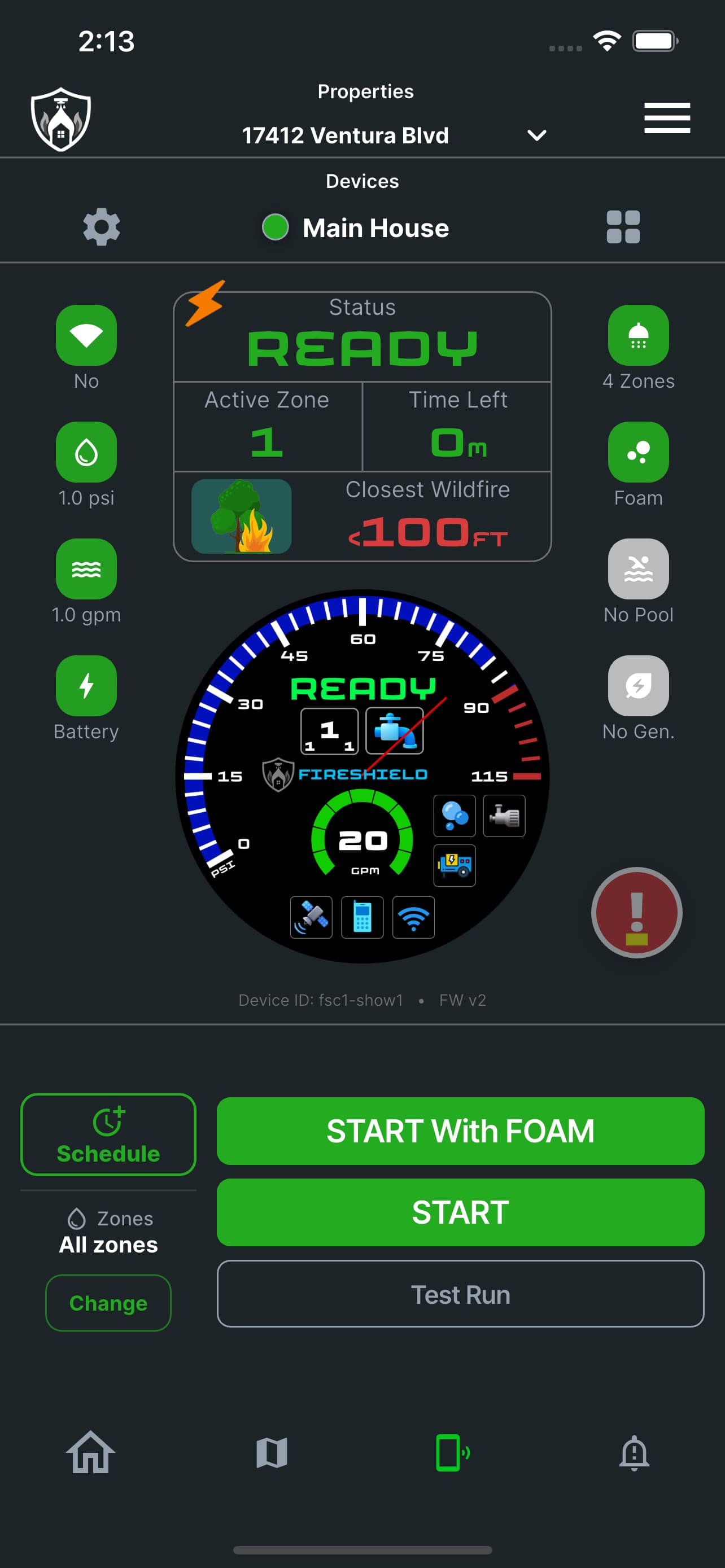
FireShield app back at READY with a badge showing automatic activation is held for that fire
Back to READY, with the hold showing on the badge.
The long version: When you press stop, it stays stopped

Can you silence one irrelevant fire without switching your protection off?

MUTE is not a real mute either

FireShield

Muting keeps automatic activation fully armed for every other fire and silences one you have looked at and judged. However it does not overlook; if any fire start moving toward your house, it will act to protect your interests.

The competition, as published

Not published. The usual alternative is turning automatic activation off — and then a new fire starts two miles away at three in the morning and nothing happens.

  • A muted fire comes back if it closes in — the same geometry as the hold.
  • Or the moment you un-mute it, from the list of everything you have muted.
  • Or after thirty days without being your closest threat, so a forgotten mute cannot outlive its fire.
  • A closer fire always wins. Nothing you tap can leave the house undefended against a fire that is actually coming.
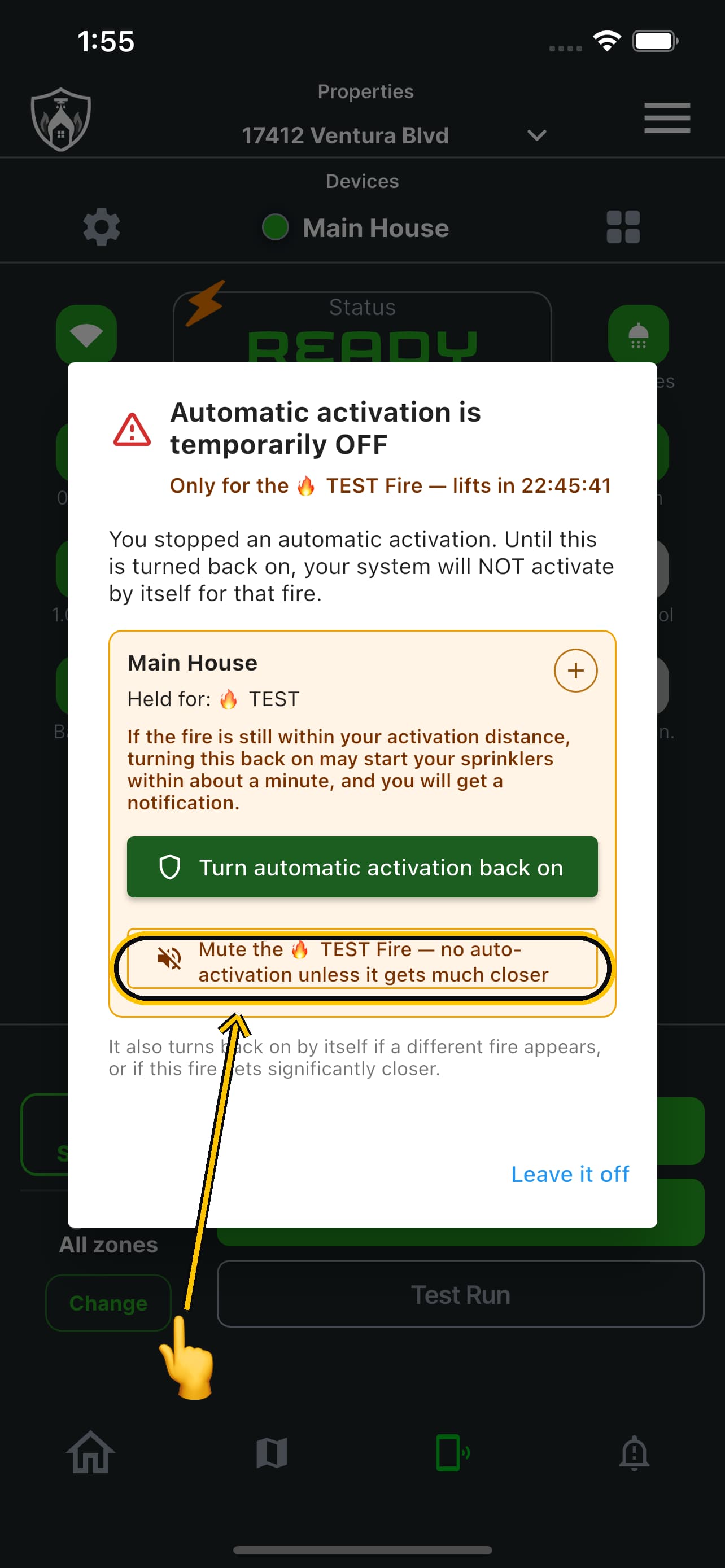
FireShield app: the hold notice with the mute option about to be pressed
Mute that fire, rather than switch the system off.
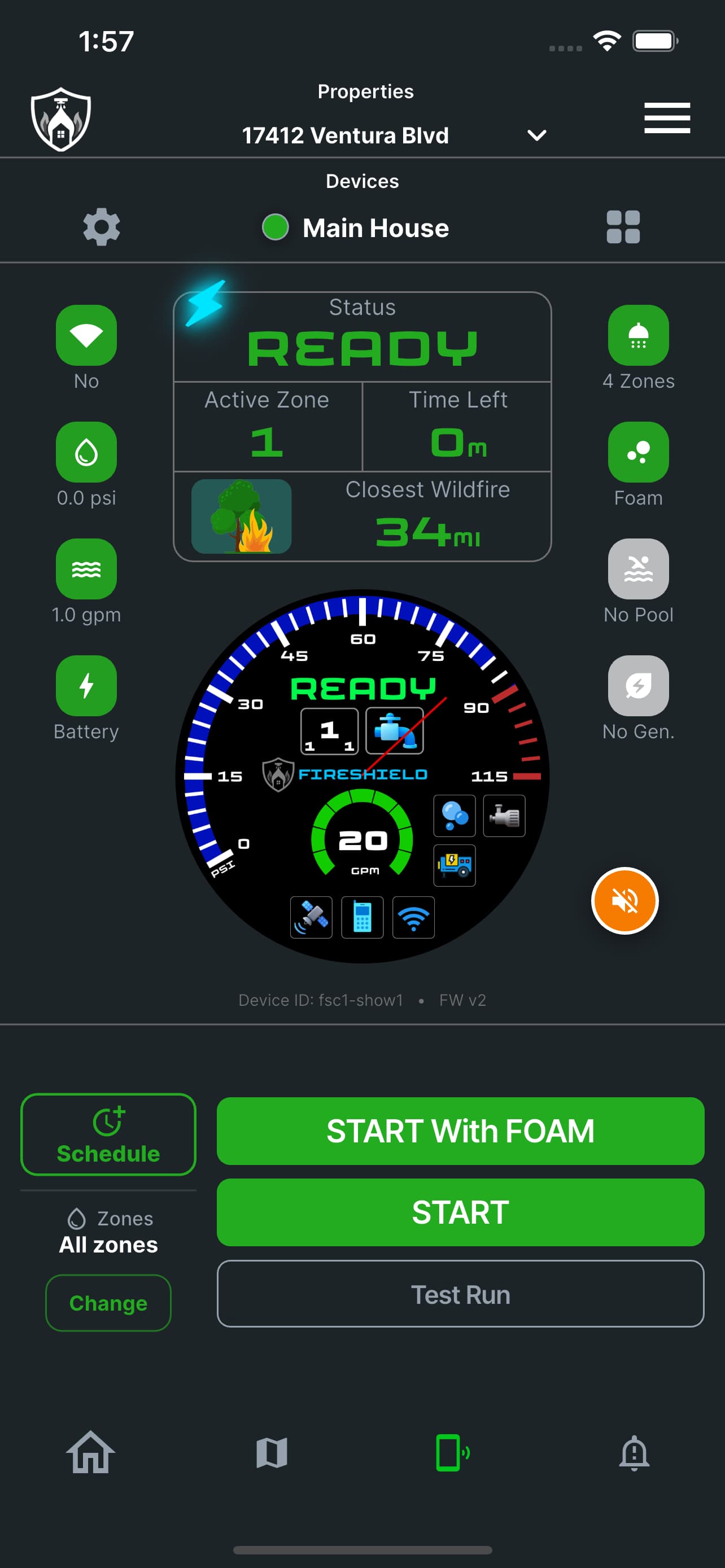
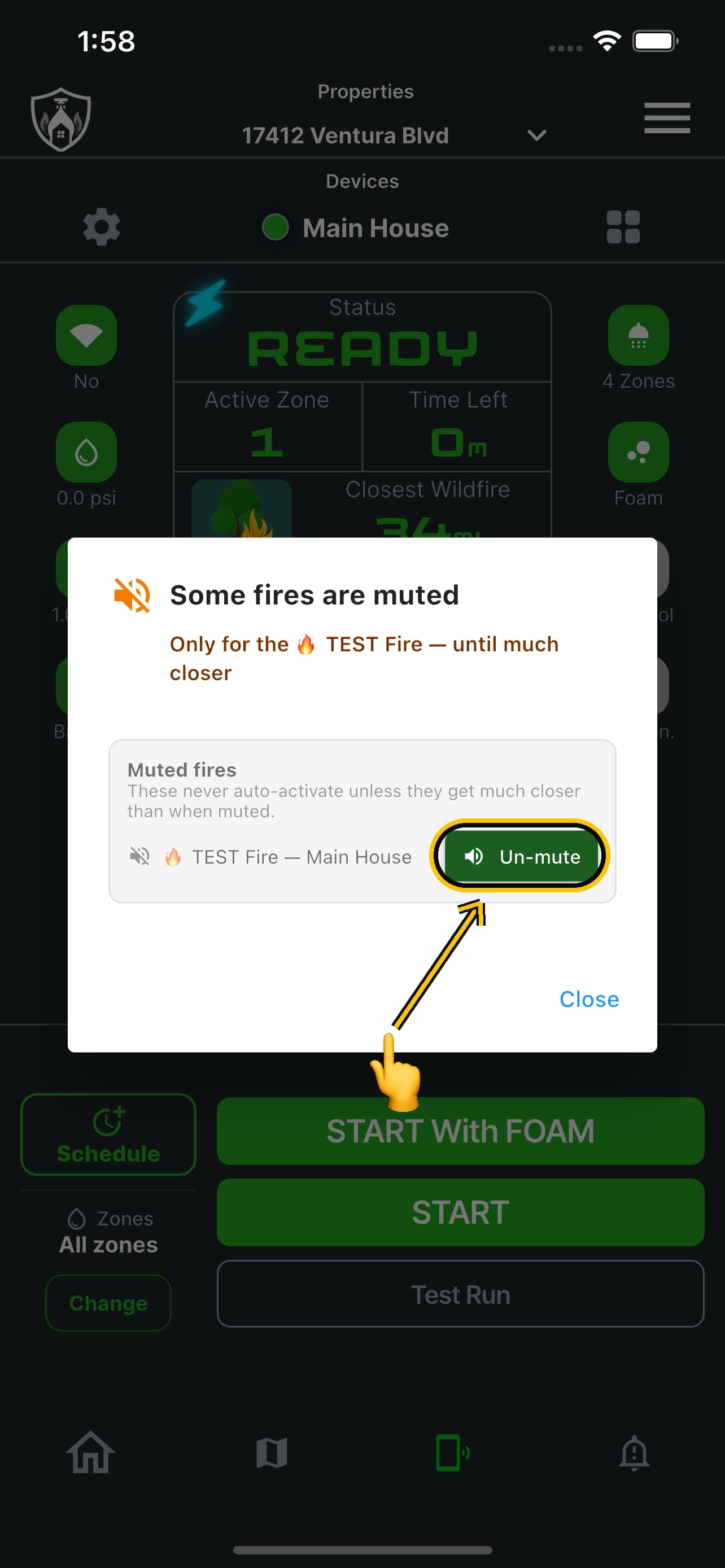
FireShield app at READY with the muted bell shown on the status badge
The badge becomes a bell.
FireShield app: the list of muted fires, with un-mute about to be pressed
Every fire you muted, and the way back.
The long version: Tell one fire to leave you alone

What is actually running the box on your wall?

Built to sit in the heat for a decade and still works like day 1

FireShield

Pre-compiled firmware on solid-state electronics. No fan, nothing to boot, no interpreter between the decision and the valve — and isolation valves that keep the manifolds unpressurized while it waits.

The competition, as published

A computerised controller with remote access is published. The control architecture is not described in detail, and pressure-isolated standby is not described.

  • A fan is a moving part, an air path for dust, and the first thing to fail in a hot enclosure.
  • An operating system is something that can update itself at the wrong moment.
  • Years of standing pressure is what ages joints and fittings.
  • The controller carries its own screen, two buttons and a switch, so a test run, a full activation and an emergency stop all work with no phone and no signal.

Solid-state electronics

No fan, because there is nothing that needs cooling.

Firmware, not an operating system

Runs on the metal. Nothing to boot, nothing to update itself mid-fire.

Pressure-isolated standby

The manifolds sit unpressurized until the system is asked to run.

The long version: Why most wildfire systems break on the hottest day

Can you see what the system is seeing?

Nothing is hidden behind a status light

FireShield

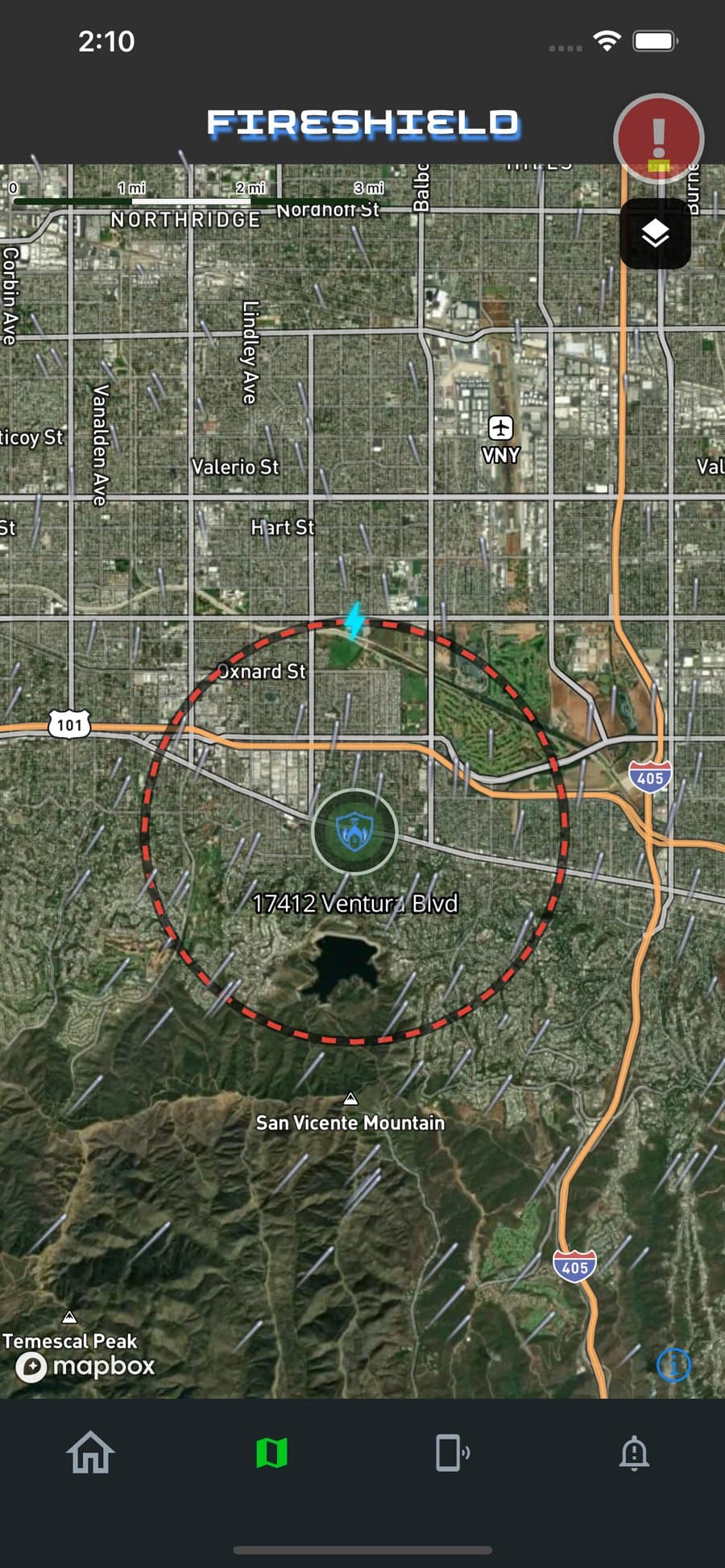
The same fire map the controller is deciding from — live perimeters, wind direction and speed against your exact position, and your activation distance drawn as a ring around the house.

The competition, as published

An app with wildfire tracking and alerts is published. The data behind the decision is not shown at the same resolution.

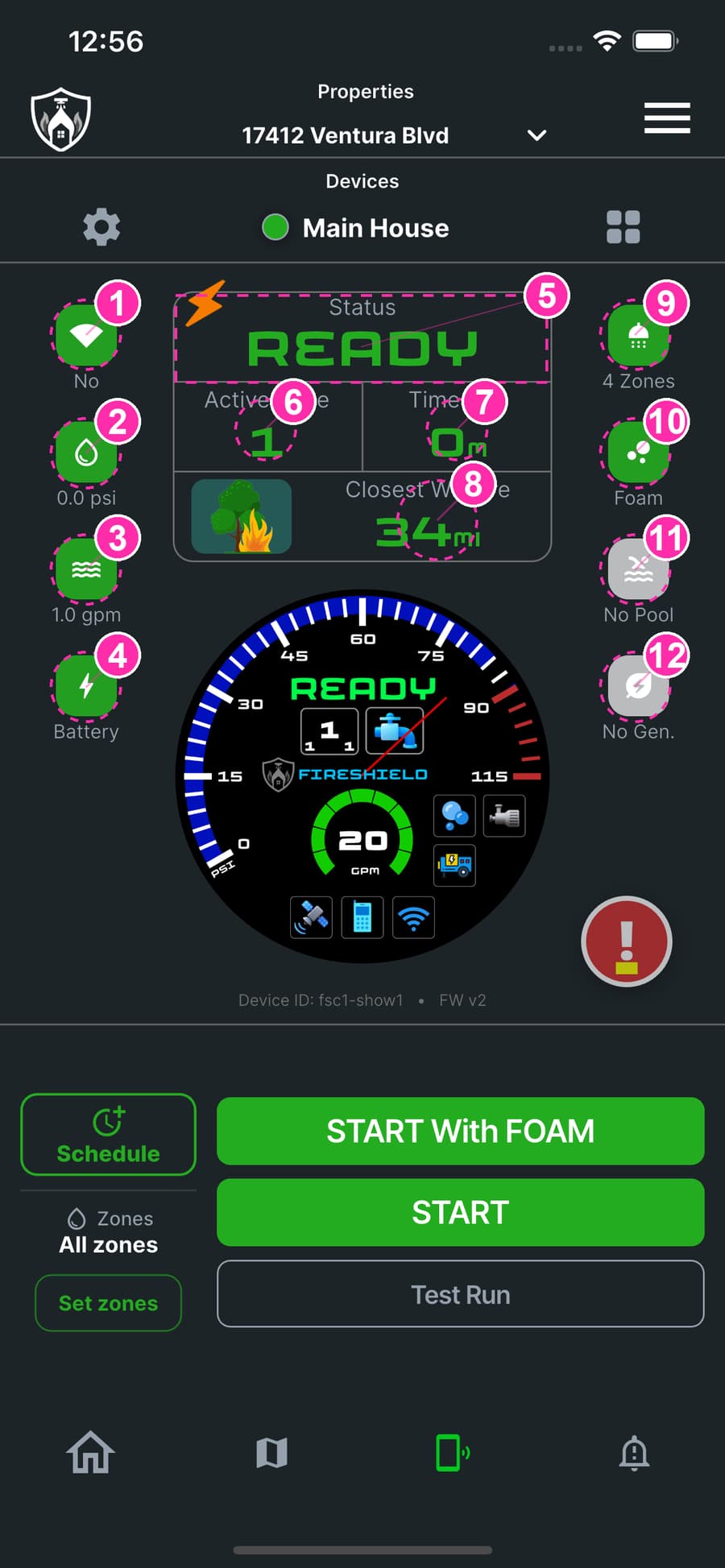
  • Every indicator on the device screen is numbered and explained, including the ones reading gray.
  • Wind is the half of this a still picture cannot carry, which is why it moves.
Live fires, and the wind actually moving across the terrain.
FireShield app: the map zoomed to the property, showing the activation distance drawn as a ring around the house
Your activation distance, drawn to scale around the house.
The FireShield device screen with every indicator numbered: connectivity, pressure, flow, power, zones, foam, pool and generator
Every reading the system has, numbered.
The long version: What happens when the cell towers go down

Side by side

Ranked by what changes the outcome for a homeowner

Not by feature count, and not in the order that flatters us. These are the questions an owner actually asks, grouped by the moment they come up — deciding, disagreeing, where the water goes, timing, what you can see, and the practical business of owning one.

FireShieldCompetition (as published)

Who decides

Can I choose how close a fire has to get?

A fire two ridges away is not the same as one two ridges away uphill, with the wind behind it.

Yes. It is a slider in the app. Set it tight for a flat street, wide for a canyon or a ridge.

Published as a fixed seven miles. No owner-set distance is published.

FireShield

Can I choose how long it waits before spraying?

That gap is your chance to look at your phone and say yes or no.

Yes, minute by minute, and you can change it from anywhere at any time.

Published as a fixed ten-minute countdown. You can start it early or override it; the ten minutes itself is not adjustable.

FireShield

Can I turn the automatic part off and still use it by hand?

The week you are re-plumbing the pool, a surprise activation is an expensive mess.

Yes. Disarm automatic activation, keep manual start.

Manual start and full remote control are published. Whether automatic can be disarmed separately is not.

FireShield

When you disagree with it

If I stop it, does it stay stopped?

These systems re-check every minute. Without care, your STOP is undone sixty seconds later.

Yes. It records which fire you declined, so the decision holds for that fire — and only that one.

You can override an activation. What happens on the next check is not published.

FireShield

Can I dismiss one particular fire without switching everything off?

A contained fire eight miles away that has not moved in three days should not keep waking you.

Yes. Mute that one fire. Every other fire still arms your system exactly as before.

Not published. The usual alternative is turning automatic activation off — which leaves you unprotected against the next one.

FireShield

If I dismiss a fire and it starts moving towards me, what then?

You should not have to remember to undo your own decision during an evacuation.

It undoes itself. If that fire closes to half the distance, or a mile nearer, the dismissal is deleted and the system arms again — with a fresh alert.

Not published.

FireShield

Where the water goes

Can I water just the side that is threatened?

Your neighbor is alight on the west fence. Everything you have should go west.

Yes. Pick the zones for the next start only, or make that your new default. Fewer zones means more pressure and a longer soak where it counts.

Runs zones in sequence to manage the water supply. Owner-chosen zones for a single run are not published.

FireShield

Can I choose foam or plain water for this particular run?

A precautionary soak in September is not the same as a fire two miles out in October.

Yes, per start — including on a start you scheduled in advance.

Class A foam is part of the system and is U.S. Forest Service approved. A per-run choice is not published.

FireShield

What happens when the street loses water pressure?

In a neighborhood fire, everyone opens a tap at once. Mains pressure is the first thing to go.

The controller brings in your pool, tank or well when mains pressure is not enough and the system is actually running.

Switches to a secondary source — pool, tank or well — when it senses a pressure drop.

Even

Can I test it without pretending there is a fire?

You want to know every zone still throws where it should, before the season, not during it.

Yes — a Test Run button, separate from a real activation.

Manual activation is published; a distinct short test cycle is not.

FireShield

Timing

Can I set it to start while I am away?

Red flag warning for tomorrow afternoon, and you will be at work.

Yes. Days, hours or minutes ahead, with your foam and zone choices attached.

Manual start from the app at any time. A future-dated schedule is not published.

FireShield

If I schedule it and a fire arrives sooner, am I stuck waiting?

A convenience feature must never be able to slow your defense down.

No. A closer fire overrides the schedule and starts sooner — still honouring the delay you set, so you keep your window.

Not applicable — no published scheduling.

FireShield

What you can see

Does it show me which way the wind is blowing?

Three miles upwind and three miles downwind are completely different nights. Embers travel on wind.

Yes. The map animates the actual wind field across the terrain, so you can see whether the air between the fire and your house is moving towards you.

Publishes wildfire tracking and fire maps. A live wind field over the terrain is not among them.

FireShield

Does it tell me the conditions at my house?

Low humidity plus rising wind is the combination that turns an ember into a house fire.

Temperature, wind, humidity, rain chance, air quality and the forecast — for the property, not the nearest city.

Fire maps and alerts are published; per-property weather and air quality are not.

FireShield

Can I see what the system itself is doing right now?

During a fire, "it is fine" is not an answer.

The app mirrors the controller: live water pressure, flow rate, which zone is running, time left, power source, and every connection.

Remote monitoring and system status through the app are published.

Even

Practical

Can I use my own contractor?

Someone is drilling into your roof and plumbing into your supply.

Your own licensed contractor, or ours.

States that its crews install the system, and that licensed contractors in each state perform installations.

FireShield

Does it still work with the power and the phone network down?

Wildfires take out both, usually at the same time.

Wi-Fi, cellular and satellite, with battery backup and an optional solar top-up.

Wi-Fi, cellular and satellite, with a dedicated backup battery.

Even

Can it grow with the property?

Outbuildings, a guest house, a bigger lot later.

Twelve zones standard, expandable past twenty-four, and more than one controller on a single property.

Systems are custom-designed per property. A published maximum is not stated.

FireShield

The hardware

How many zones can it grow to?

A big property, an outbuilding or a second structure should not mean a second system.

Twelve zones as standard, expandable past twenty-four on the same controller.

Multiple zones supported; expansion beyond the standard build is not published as a single-controller capability.

FireShield

Is the plumbing under pressure while it waits?

A system spends years waiting. Standing pressure is what ages joints and fittings.

No. Isolation valves keep the manifolds unpressurized in standby, which is the point of the design.

Pressure monitoring is published; pressure-isolated standby is not described.

FireShield

What is actually running the controller?

The day it matters, it has to wake up and open a valve. Nothing else.

Pre-compiled firmware on solid-state electronics. No fan, no operating system, nothing to boot.

A computerised controller with remote access; the control architecture is not published in detail.

FireShield

When the pool pump runs

A pump that cycles on its own wears out before the fire arrives.

Only when city pressure is genuinely insufficient and the system is engaged — both conditions, judged by the controller.

Published as pressure-sensor and VFD driven.

FireShield

The competition column describes only what competing companies publish about their own systems. This page is not affiliated with or endorsed by any of them. Specifications change; check anything decisive with each company directly.

Read this before you decide anything

We make one of the products on this page, so treat our description of our own system as what it is — our account of it. We believe it is the better answer for the homes we install on, and we would say that.

Everything here about the competition describes what we could find published at the time we wrote it. It may be incomplete. They may have built things we did not find, published details somewhere we did not look, updated their site since, or answered questions elsewhere that would change what is written here. Any of that would be our omission, not their fault.

This page is not maintained on a schedule. It can be out of date and still be sitting here.

So do not choose a wildfire system because of this page. Compare them yourself, ask each company directly, and make them answer your questions about your property. Ask us the hard ones too.

Have a look at your own roof before you decide

Coverage depends on your roofline, your water supply and how the wind runs through your street. We will tell you what your property needs — including when the honest answer is that you do not need us.