The short version
- A fire can sit near you for days without being a threat. Turning off automatic activation to stop the alerts leaves you unprotected against the next ignition.
- FireShield lets you mute one named fire. Every other fire still arms your system normally.
- The mute is not a promise. If that fire closes in meaningfully, the mute is deleted and the system activates anyway.
- Muted fires that stop being your nearest threat are cleared out automatically after thirty days.
- Ask any competitor: can I dismiss one specific fire without disarming the whole system?
Here is a situation every Californian in a fire area recognises.
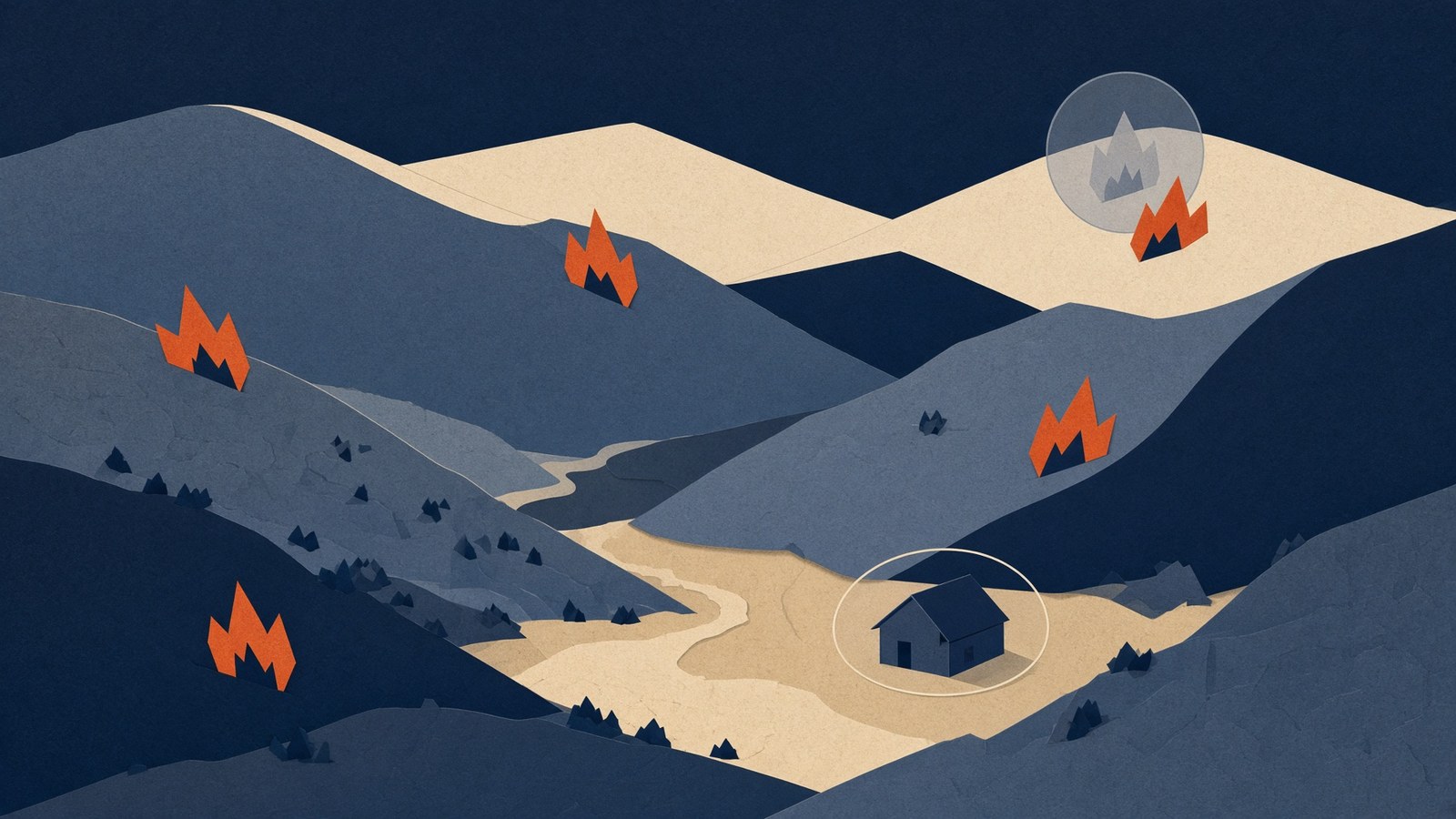
There is a fire in the hills. It started four days ago, it is eighty per cent contained, and it has not advanced since Tuesday. It is eight miles from your house, which is inside the distance you set for automatic activation. Your phone tells you about it. Your system is armed because of it.
You know it is not coming. The fire crews know it is not coming. But your system only knows one number: how far away it is.
On most systems you have exactly two options. Live with the alerts, or switch automatic activation off. The second one is the dangerous choice, and it is the one people take — because the alerts are exhausting, and switching them off feels like a small thing at the time.
Then a new fire starts two miles away at three in the morning, and the system that would have wet your roof is sitting there disarmed because of a fire that never moved.
A mute that applies to one fire and nothing else
FireShield lets you mute a fire individually. Not alerts in general. Not automatic activation. That fire.
The system stores the fire's identity and the distance it was at when you muted it. From then on, that fire no longer arms your system. Everything else is untouched — a new ignition anywhere, at any distance inside your threshold, activates exactly as it would have before.
The identity matters more than it sounds. FireShield uses the fire agency's own identifier for the fire, which stays the same as the fire grows and its mapped boundary changes shape. Muting by name alone would break the moment an agency renamed a complex or merged two fires. Muting by identity holds.
The part that protects you from your own decision
A mute you can never take back is a trap. People mute a fire on Tuesday, forget by Thursday, and the fire moves on Friday.
So the mute has geometry attached to it.
FireShield records how far away the fire was when you muted it — call it your mute distance. If that fire later closes to either half that distance, or a full mile nearer, whichever it reaches first, the mute is deleted and the system arms against it again. Immediately, in the same processing cycle, with a fresh notification so you cannot miss it.
Both halves of that rule exist for a reason. Halving alone is too slow for a distant fire: mute at eight miles and you would ignore four miles of approach. A purely relative rule is too twitchy for a near one, because fire boundaries are estimates that wobble by a few hundred feet between updates, and you do not want a re-arm every time an agency refreshes an acreage figure.
Half, or a mile — whichever comes first. Far fires get caught early. Near fires do not cry wolf.
You are allowed to say "not that one". You are not allowed to say it in a way that leaves you undefended when that one changes its mind.
It tidies up after itself
Mute enough fires over enough seasons and you would accumulate a list nobody reads — the exact condition where an old entry silently suppresses something that matters.
FireShield purges any muted fire that has not been your nearest threat for thirty days. It happens in the same write as everything else, without asking you, because a housekeeping task that needs the owner's attention is a housekeeping task that never runs.
Unlike the decline window described below, a mute has no automatic time limit of its own. It is meant for a fire you have genuinely assessed and set aside. Its exit is geometry: the fire coming closer, or the fire ceasing to matter.
Why this is not on the spec sheet anywhere else
Muting one fire is a strange feature to build. It only makes sense if you accept two things most manufacturers will not say out loud.
The first is that the homeowner knows things the system does not. You know the canyon between you and that fire is bare rock. You know the crews have been on it for three days. Your system knows a distance. A product built on the belief that the machine is always right cannot offer this feature, because offering it means admitting the machine can be usefully overruled.
The second is that alert fatigue is a safety problem, not an annoyance. Every unnecessary alert makes the next one slightly less likely to be read. A system that cannot be quietened about one irrelevant fire is a system that trains its owner to ignore it — and then the real alert arrives and nobody looks.
The leading competing system publishes automatic activation when a fire is within seven miles, with a ten-minute countdown you can start early or override. That is a good default. What is not published is any way to say "that particular fire, no" and keep the rest of your protection armed.
What to ask, whatever you buy
- Can I dismiss one specific fire without disarming the system against every other fire?
- If I dismiss one, what brings it back — and is that automatic or do I have to remember?
- How long does the dismissal last?
- Does dismissing use the fire's identity, so it survives the fire being renamed or growing?
If the answer to the first is "you can turn off automatic activation", that is not the same feature. That is the thing this feature exists to stop you from doing.