
The short version
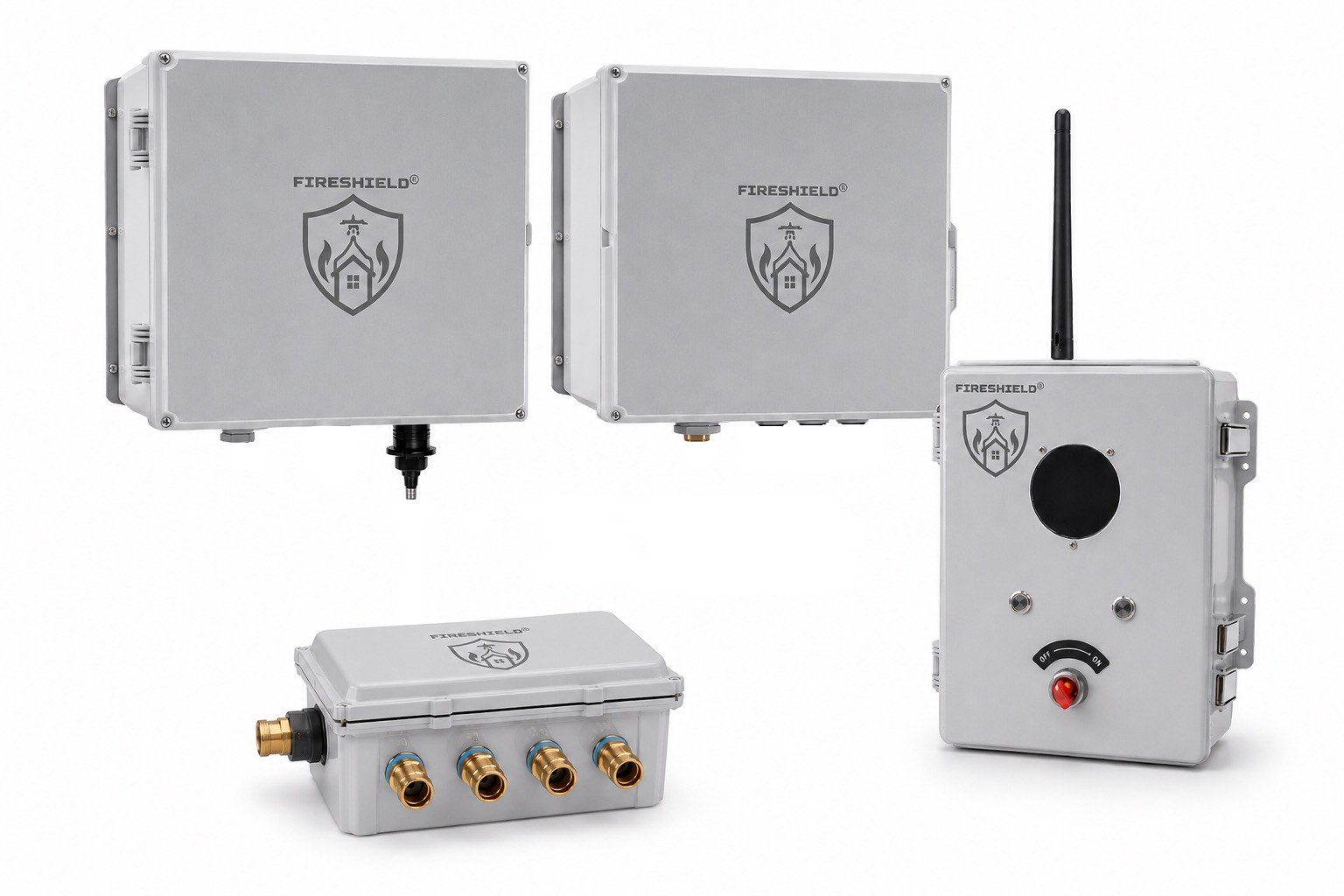
- FireShield doesn't build a small system and a big system. It builds one system and configures it.
- A single FireShield controller handles up to 36 zones. Many controllers in this category top out around 8 to 12 zones per unit.
- That matters because two controllers on one water supply can't see each other's zones, and end up fighting over the same pressure.
- Foam, satellite, and extra manifold sections are modules you can add later without redoing the wiring or the plumbing.
- If you're comparing FireShield with other systems, ask each of them: what changes if I add six zones in two years?
Most articles about a product like this are written for the buyer. This one is written about the factory, because how a thing is made determines what it can do for you later — and almost nobody asks.
Part 01: The two ways to sell twelve different systems
Say you protect houses ranging from a small cottage to a hillside estate. Eight zones to ninety-six. You need to cover all of it. There are two ways.
Build a range. A small controller, a medium one, a large one. Different boards, different enclosures, different part numbers. Three sets of spares, three sets of software, three things to test whenever anything changes. And when a customer outgrows their controller, they buy a different one.
Build one, and configure it. One board. One enclosure. One software image. What differs between the cottage and the estate is a settings file that says how many valves exist, how they're grouped, and what order they run in.
FireShield does the second one — and what that means from your side of it is its own article. It's the first claim in FireShield's patent application: the controller reads a configuration file at runtime and determines from it the number of valves, their grouping into zones, and the activation sequence — "independent of any modification of the executable firmware."
Every FireShield controller leaving the bench is identical. The house is a text file.
Part 02: What that does that you can actually feel
Four consequences, all of which land on the customer eventually.
One spare, not five. When something needs replacing in year seven, there is one part to have on a shelf. Not the discontinued mid-range board from 2026 that nobody stocks anymore.
One software image, tested once. Every FireShield controller in the field runs the same software. A fix tested on one is tested on all of them. Nothing exists in the field that's running a variant nobody remembers.
A mistake costs a file edit. This is the one installers care about. If a valve is wired backwards or a run time is wrong, the fix is a setting — not a new software release pushed to a life-safety device. FireShield's patent is explicit that this "removes the delay and the risk of introduced defects that a firmware change to a life-safety device entails."
Growing is cheap. Add six zones and you have not outgrown your FireShield controller. You've changed a number.
Part 03: The 36-zone number, and why it isn't bragging
Here's a specific claim in FireShield's patent that's easy to skim past.
A single FireShield controller can run up to 36 zones. For comparison, the patent notes that controllers of this general type conventionally manage on the order of 8 to 12 zones per device — which means a larger property needs several of them.
The patent then explains why that's a problem, and it isn't about tidiness.
Two independent controllers on one property don't know about each other. Each one has its own idea of which zones are open. Both draw on the same residential water supply. So both open zones at the same time, and — in the patent's language — they "starve the discharge devices of the pressure required to operate."
Neither controller is broken. Neither is badly made. They simply can't see each other, and the water supply doesn't care about org charts.
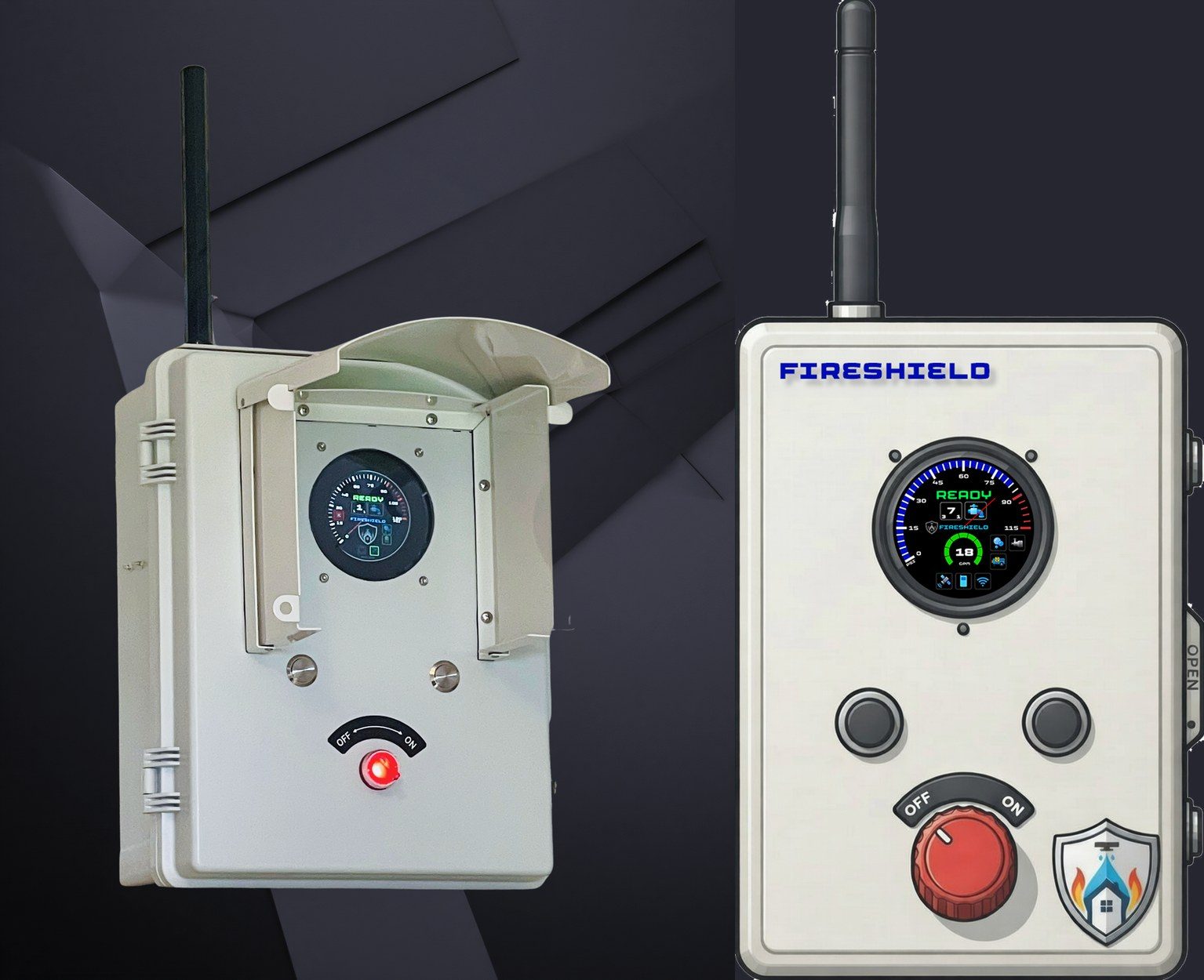
One FireShield controller, aware of every zone and reading actual supply pressure, sizes its zone groups so the sprinklers that are running actually work. One settings file. One sequence. One record of what happened.
And when a property genuinely needs more than one system — separate structures sharing a supply — FireShield controllers talk to each other, by wire, by radio, or through the cloud, so one holds back while the other delivers.
Part 04: The parts you add later
Same idea, applied to the plumbing and the radios.
Foam. A FireShield system can be installed without the additive assembly, with the port capped. Add it later and — per the patent — it goes on "without modification of the controller wiring, the firmware, or the fluid layout." Its use is then switched on in the settings file.
Satellite. The satellite radio is a module with its own processor. It can be swapped for a newer one in a later revision without redesigning the FireShield controller. Satellite hardware moves fast; the controller on your wall shouldn't have to.
More manifold. Each FireShield manifold has an end port that doubles as a flush point and an extension point. Another section bolts on there.
Third-party gear. FireShield has a contact-closure output that acts like pressing a button on another device — a siren, an older system, whatever's already on the property — and an accessory input for a panic button or camera. Both configurable, both without touching the FireShield hardware.
Part 05: Why this is a safety argument, not a manufacturing one
It would be easy to read all of the above as efficiency — fewer parts, simpler inventory, better margins. Real, but not the point.
The point is how much has to change when something needs to change.
A system built as a range of models has more distinct things in the field than anyone can hold in their head. A fix for the big controller may or may not apply to the small one. The one installed in 2026 is running something slightly different from the one installed last month.
A system built as one configurable controller has exactly one thing in the field. Everything else is a text file that can be read, checked, corrected, and re-read in seconds.
For a device that has to work correctly on one unpredictable day after years of sitting still, that's a reliability argument. The factory decision and the safety decision turn out to be the same decision.
What to ask before you sign
| Question | Why it matters |
|---|---|
| How many zones on one controller? | FireShield: up to 36. Ask where the ceiling is before a second controller is needed. |
| What if I add zones in two years? | With FireShield it's a settings change, not new hardware. |
| If I need two controllers, do they coordinate? | FireShield controllers talk to each other so they don't fight over one supply. |
| Can I add foam later? | FireShield caps the port and adds the module later, with no rewiring or replumbing. |
| Can the satellite hardware be upgraded? | FireShield's is a module — replaceable without redesigning the controller. |
Ask FireShield. Ask the competition. Ask anyone else you're considering.
There's no marketing in a decision like this. Nobody buys a wildfire system because of how the manufacturer manages part numbers.
But the reason a FireShield system can be corrected without a truck roll, grown without new hardware, and fixed identically everywhere at once, is that FireShield only ever built one of them.
Next in this series
- The Setting You Can Change in Ten Seconds — The settings file, from the homeowner's side.
- Why Most Wildfire Systems Break on the Hottest Day — The cooling fan and the computer, and why FireShield has neither.
- Skip the Zones You Don't Need — Watering only part of your property, and why that's the whole point.
- What Actually Has to Work When Nobody's Home — The whole system, start to finish, in plain English.
About FireShield — FireShield builds automated exterior wildfire defense systems for homes across Southern California. The system described here is covered by FireShield's patent. See the wildfire defense system or talk to us.