The short version
- The day it matters, you won't be there. The power will be out and the internet will be gone. Everything has to happen unattended.
- FireShield's protection isn't one feature — it's four stages that have to hand off correctly: waiting, arming, running, shutting down.
- The hard part isn't spraying water. It's spending years doing nothing without quietly breaking, then working perfectly once.
- Most of what FireShield does is arranged around not being there — no fan to fail, no server to ask, no person to press anything.
- If you're comparing FireShield with other systems, ask each of them to walk you through all four stages, not just the spraying one.
Every wildfire system demo is the same. Someone taps a phone, water comes off a roof, everybody nods.
That demo is the easy part. It's five minutes out of a chain that starts years earlier and has to survive an evacuation, a blackout, and a dead cell tower to get there.
So here's the whole chain, in order, in plain English. Not a feature list — the actual sequence, and what has to be true at each step.
Part 01: Waiting — the four years nobody thinks about
Your FireShield system spends almost its entire life doing nothing. That's not downtime. It's the stage where systems quietly die.
The pipes are empty. This is the single most underrated decision in the whole design. A FireShield system holds a valve closed at the water supply, so the network of pipes running up your walls and across your roof sits unpressurized when it's not in use.
Why it matters: a pipe under constant pressure is a pipe slowly working on every joint, fitting and threaded connection, through six summers of heat. Leaving it empty removes years of that. And a leak in your roof network in August is a far more likely event than a fire in October.
Losing power means losing water, not gaining it. The valve is normally closed. Cut the power, cut a wire, fail the controller — the water shuts off. FireShield's patent gives the reason directly: it protects against "runaway water use, water cost, and flooding of an unattended structure."
That's the nightmare version of this product — a system that dumps water into an empty house for three days. FireShield's default failure is dry.
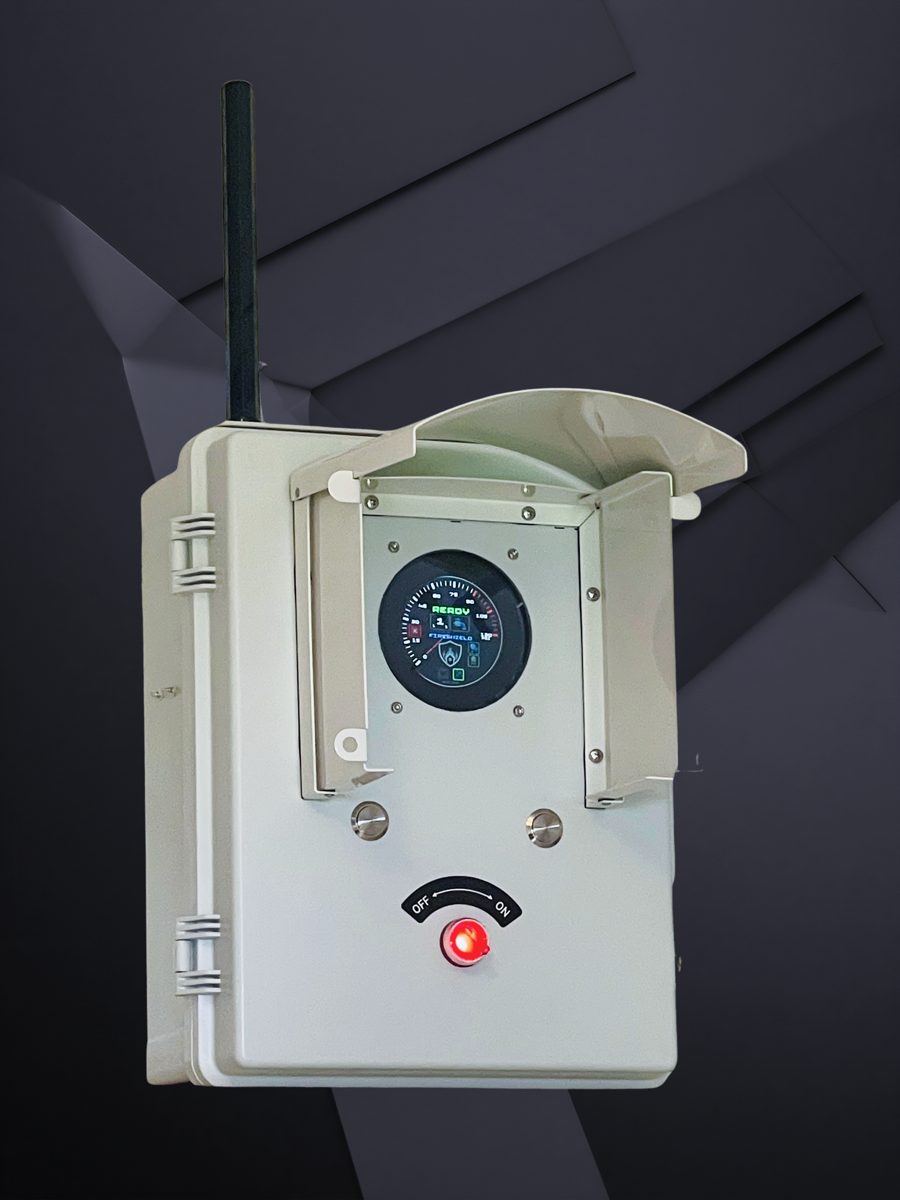
Nothing is wearing out. No cooling fan, no vents, no filter to service. There's a whole article on this; the short version is that the parts most likely to fail after four idle years simply aren't in the controller.
Something is still watching. Meanwhile FireShield checks in with its servers on a schedule you set, reporting that it's alive and healthy — so "it's been fine for four years" is a thing somebody actually knows, rather than assumes.
The hardest thing a wildfire system does is spend four years not breaking.
Part 02: Arming — deciding it's time
A fire starts somewhere. Now the question is whether your house is in trouble, and FireShield has more than one way to answer it.
The far-away answer. FireShield's servers pull in fire data from several sources at once — official perimeter feeds, satellite heat detections, camera detections — put them all into one common format, and remove duplicate reports of the same fire. That merged picture feeds a risk calculation that estimates, for specific coordinates, the probability of burning.
That's a whole article by itself. What matters here is that it produces a decision, and the decision reaches your hardware.
The simple answer. FireShield also supports a plain distance rule: when the nearest edge of a fire is closer than the number you chose, start. Or start in twenty minutes, with a countdown you can cancel.
The local answer. A button on the FireShield controller. A wireless button you press while evacuating. Heat, smoke, flame, or camera sensors wired to the controller.
This is the design point most worth understanding: FireShield doesn't care which of these decided. The same hardware responds the same way to a risk calculation, a distance threshold, a sensor, or your thumb. Three of the four paths need no internet at all.
Part 03: Running — twenty minutes of hard problems
Say the command lands. Here's what happens, and every step is a place a lesser design gives up.
It writes down what it's about to do — first. Before any water moves, FireShield records that it's active, which zone is starting, and where it is in the sequence. Everything after this point is recoverable because of this step.
It opens the supply and checks the pressure. The isolation valve opens. FireShield reads what's actually available rather than assuming.
It runs zones in groups sized to that pressure. You do not have enough water to run every sprinkler at once — nobody does. FireShield energizes zones in subsets chosen from measured pressure, so the heads that are running hold working pressure instead of all of them dribbling.
It hands off gently. Moving to the next zone, FireShield opens the next valve before closing the last. That avoids the pressure slam that, over years, cracks fittings and loosens roof hardware.
It drives each valve by its own numbers. A high-pressure valve may need 25 to 30 seconds of travel; a low-pressure one, 1 to 10. Each FireShield valve gets its own timing from the settings file.
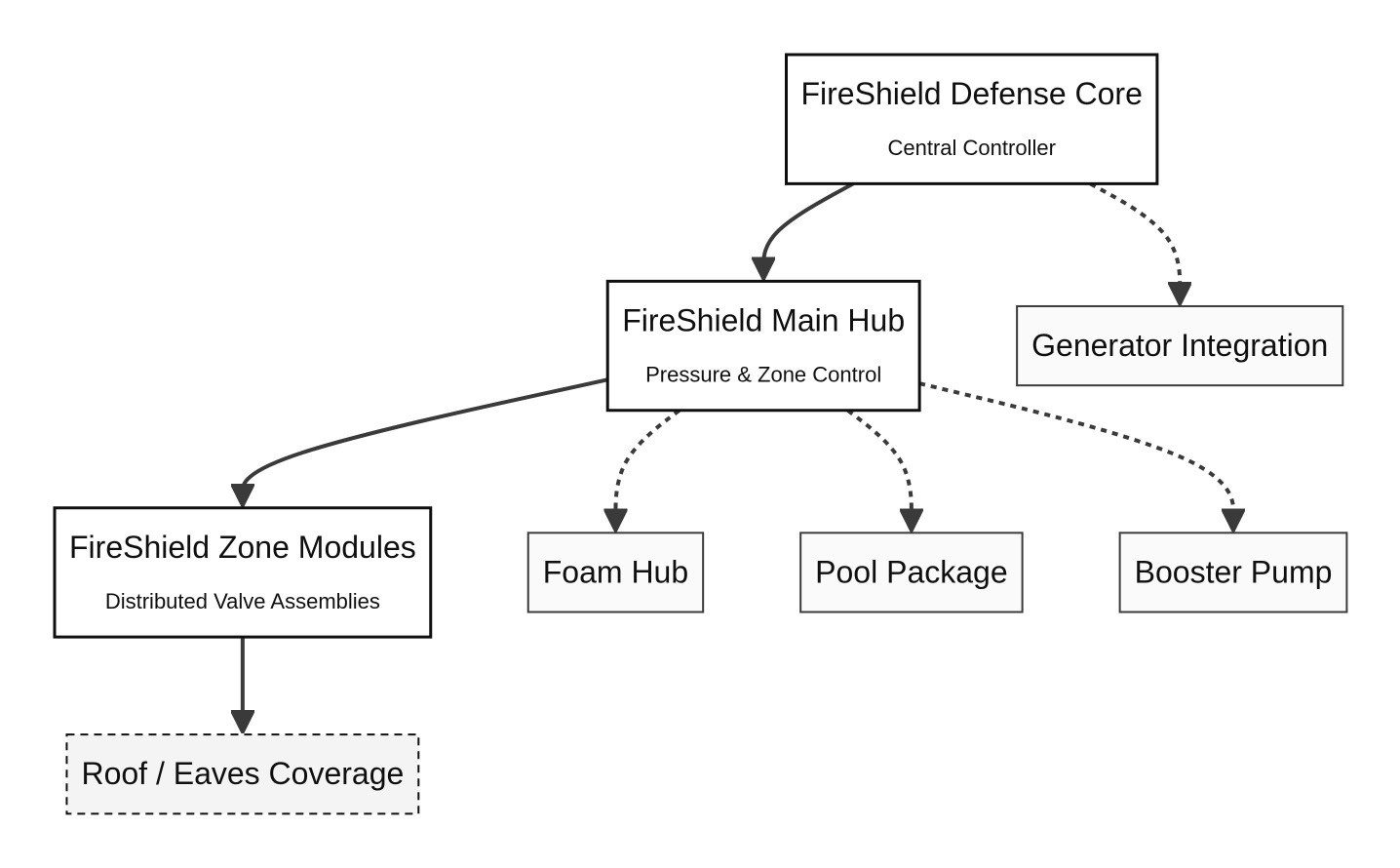
Water runs low, so it finds more. When supply pressure drops below your threshold — and only because the system is actually running — FireShield starts the pump on your pool, tank, or well. Both conditions are required. A pressure dip on an ordinary Tuesday never touches your pool.
The power dies, so it makes its own. Same logic for the generator: FireShield runs it only when the system is active and utility power is gone. Not for ordinary grid blips.
It concentrates where the fire is. If FireShield knows the approach direction — from its risk analysis or an on-site wind sensor — it favors the zones on that face, giving them longer turns and more of them, and drops zones on the sheltered side. Limited water goes to the exposed side.
Something resets, and it picks up where it left off. A brownout, a reset, a watchdog trip. FireShield reads the record it wrote in step one, drives every valve to its correct position, and resumes from the exact zone it was on — "without re-establishing communication with a remote backend." It doesn't need to ask anyone. It already knows. More on what survives a blackout.
You override it, on purpose. Normally, when backup power runs out, the isolation valve closes and the water stops — the fail-safe. But you can tell FireShield in advance, or during the event, to open a bypass and keep water flowing anyway, past the point where it would otherwise shut itself off. One decision, two coherent behaviors: maximum protection, or fail-safe. Yours to pick.
Part 04: Shutting down — the stage nobody demos
It's over. This part decides whether the system works next time.
Drain the network. FireShield empties the pipes through a drain branch, so nothing is left sitting in lines on your roof.
Optionally flush. If you ran foam, FireShield can push plain water through to clear residue out of the nozzles — otherwise dried additive is exactly what clogs heads between events.
Drain again.
Close the supply, and go back to empty. The isolation valve returns to closed. The network is unpressurized again. FireShield reports that it finished, and the event is recorded.
And it's back in stage one, waiting — which is where it will spend the next several years.
Part 05: The thing that's actually being claimed
Read those four stages again and notice what almost none of it is about.
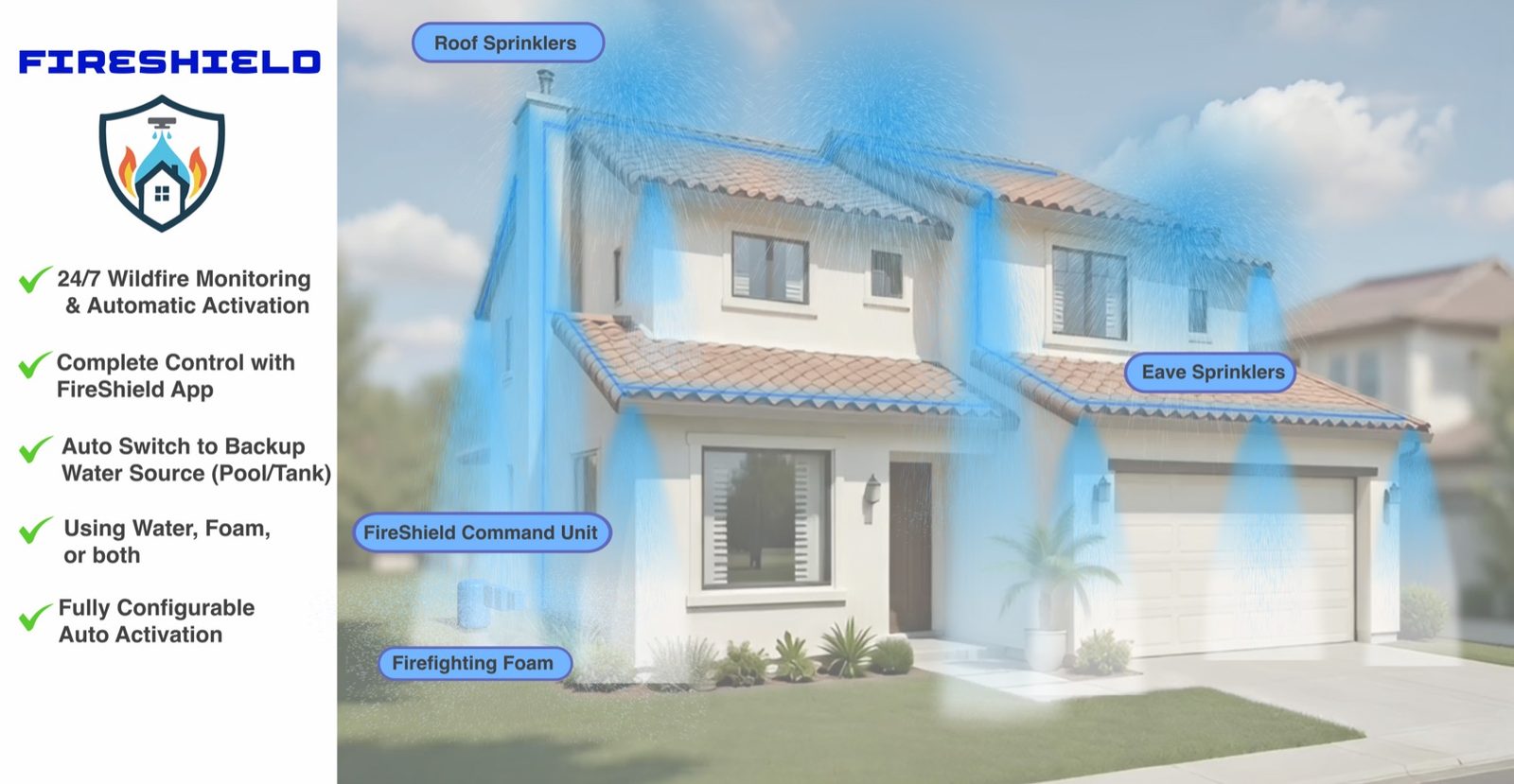
Almost none of it is about spraying water. Spraying water is easy. The design is mostly arranged around nobody being there.
No fan, because nobody will service it. Empty pipes, because nobody will notice a slow leak. Fails dry, because nobody will find a flood for a week. Four ways to start, because nobody can press a button. Remembers its place, because nobody can restart it. Runs its own shutdown, because nobody will drain the lines.
FireShield's patent makes the argument directly, and it's the honest version: no single one of these features produces the result. The controller reading its settings at runtime is what lets one controller handle any property. That same awareness of every zone is what makes pressure-correct sequencing possible. The two-condition interlock is what lets a limited pool be used without being wasted. Fail-safe isolation is what makes an empty house safe. Its memory is what carries a run through a blackout.
They only work as one thing.
The question isn't whether it sprays water. It's whether every one of these hands off correctly, on a day nobody is watching.
What to ask before you sign
| Question | Why it matters |
|---|---|
| Are the pipes pressurized while it's idle? | FireShield keeps its network empty in standby. Years of pressure is years of wear. |
| What happens if it loses power mid-run? | FireShield's water shuts off by default — and it resumes the sequence from where it stopped. |
| How many ways can it start without internet? | FireShield has three. |
| When does it draw from my pool? | Only on low pressure and an active run. Never on a random Tuesday. |
| What does it do after it finishes? | FireShield drains, optionally flushes, drains again, and re-isolates. Ask what happens elsewhere. |
Ask FireShield. Ask the competition. Ask anyone else you're considering. Ask them to walk all four stages, not just the spraying one.
On the day this matters, you will be somewhere else, watching your phone, on a road with a lot of other cars on it.
Everything above has to happen without you.
That's the product.
Next in this series
- Why Most Wildfire Systems Break on the Hottest Day — The cooling fan and the computer, and why FireShield has neither.
- The Setting You Can Change in Ten Seconds — Why your system's personality lives in a settings file.
- What Happens When the Cell Towers Go Down — Four ways to start, and what survives a blackout.
- Skip the Zones You Don't Need — Watering only part of your property, and why that's the whole point.
About FireShield — FireShield builds automated exterior wildfire defense systems for homes across Southern California. The system described here is covered by FireShield's patent. See the wildfire defense system or talk to us.